techXXX
Transmission and Drivetrain Layout of a V12 GT—My Car Company 08
Today, let us move onto the transmission as well as the drivetrain layout of Type 1, my mid-size superlight grand tourer.
Published by Dr Jiulin Teng on 25 Jan 2026
Previously, I have discussed all major aspects of the 3L naturally-aspirated high-revving V12 that will power the mid-size grand tourer that I would build, Type 1. Today, let us move onto the transmission as well as the drivetrain layout.
7-Speed Manual Transmission
Type 1 will come exclusively with a 7-speed manual transmission bolted directly onto the engine. Three aspects are worth noting. First, manual transmission is chosen for its match with the character of the vehicle and our company. It gives full control to the driver and is still and will always be the most engaging of all transmission types. Beyond the driving experience, Type 1 is a superlight GT, and every kilo matters. Manual transmission is the lightest of all. From a mechanical standpoint, it is also the purest, most honest option with no electronic nonsense. It is exceptionally robust and will always be the most efficient in terms of power transmission. Regarding the last point, even though modern 8- or 10-speed automatics may have lower official consumption numbers by lugging the engine during tests, physics does not bend to the will of marketing copies.
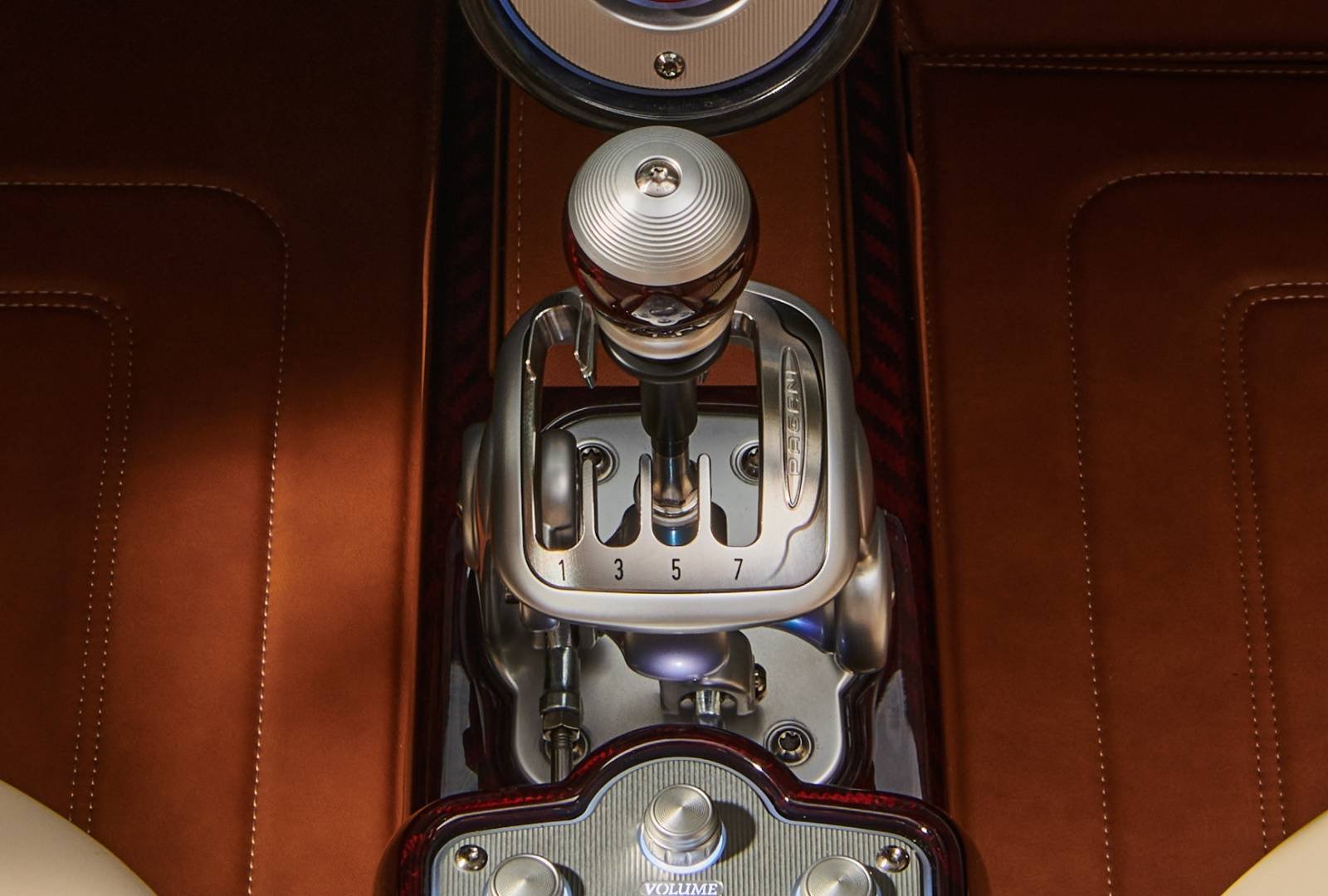
Second, our manual transmission should have 7 forward gears in order to have a wide gear spread and close gear steps throughout. We should use an exposed shift gate much like the one found in the Pagani Utopia. Unlike the Pagani, however, the shifter would go directly into the transmission without additional linkages. Tentatively, the gear ratios would be:
- 1st Gear: 4.00:1
- 2nd Gear: 2.60:1 (step 1.54)
- 3rd Gear: 1.79:1 (step 1.45)
- 4th Gear: 1.30:1 (step 1.37)
- 5th Gear: 1.08:1 (step 1.20)
- 6th Gear: 0.92:1 (step 1.17)
- 7th Gear: 0.75:1 (step 1.23)
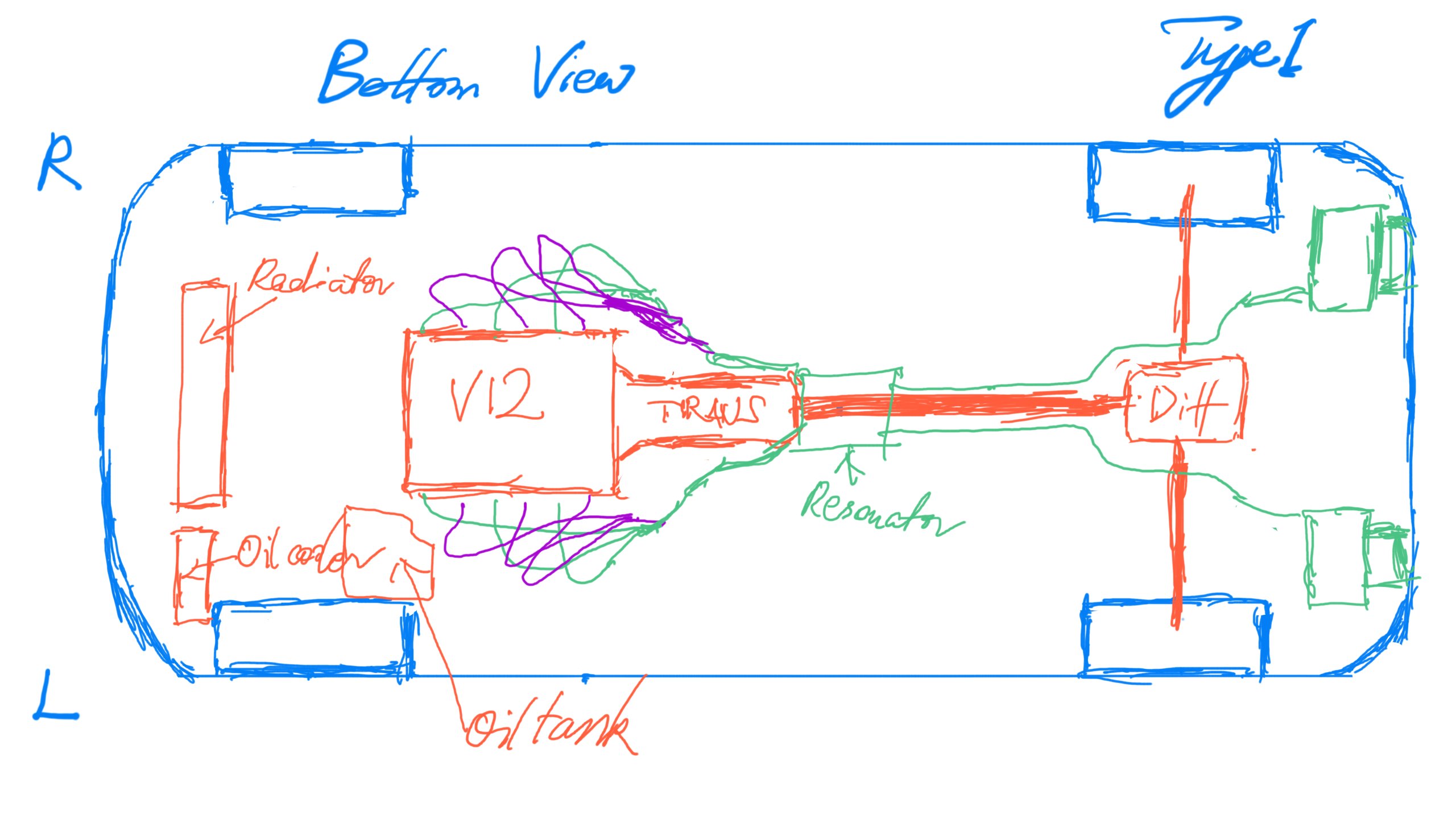
Third, we do not use a rear transaxle for three reasons. One, the weight distribution advantage of a transaxle is minimal for Type 1. Because the GT is reasonably long but its engine is very compact, with the block measuring about 60cm only, even the front of the engine will be behind the front wheels. A compact manual transmission bolted directly on the engine will be close to the center of the vehicle. Thanks to its lightness, the impact on weight distribution is small. Two, if we used a transaxle setup, we would add a lot of cost, complexity, and weight. In particular, the torque tube would be rotating at the engine speed, which is not ideal. Three, the long linkages would compromise the shifter feel.
Torsen LSD
For sporty driving, it is advantageous to have a limited slip differential. While modern electronic LSDs with multiple clutches can be superior in exceptional scenarios, a pure mechanical setup is lighter, maintenance-free, and exceptionally robust while being proactive. For our road-going GT, a Torsen LSD cannot be beaten. Compared to an open differential, we are adding between 5kg and 9kg, which is acceptable when the power can be put down on the road better.

Vehicle Dimensions and Drivetrain Layout
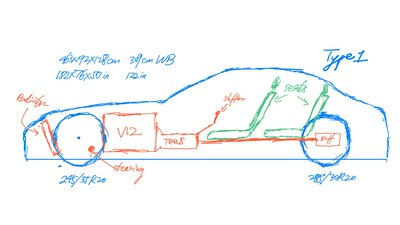
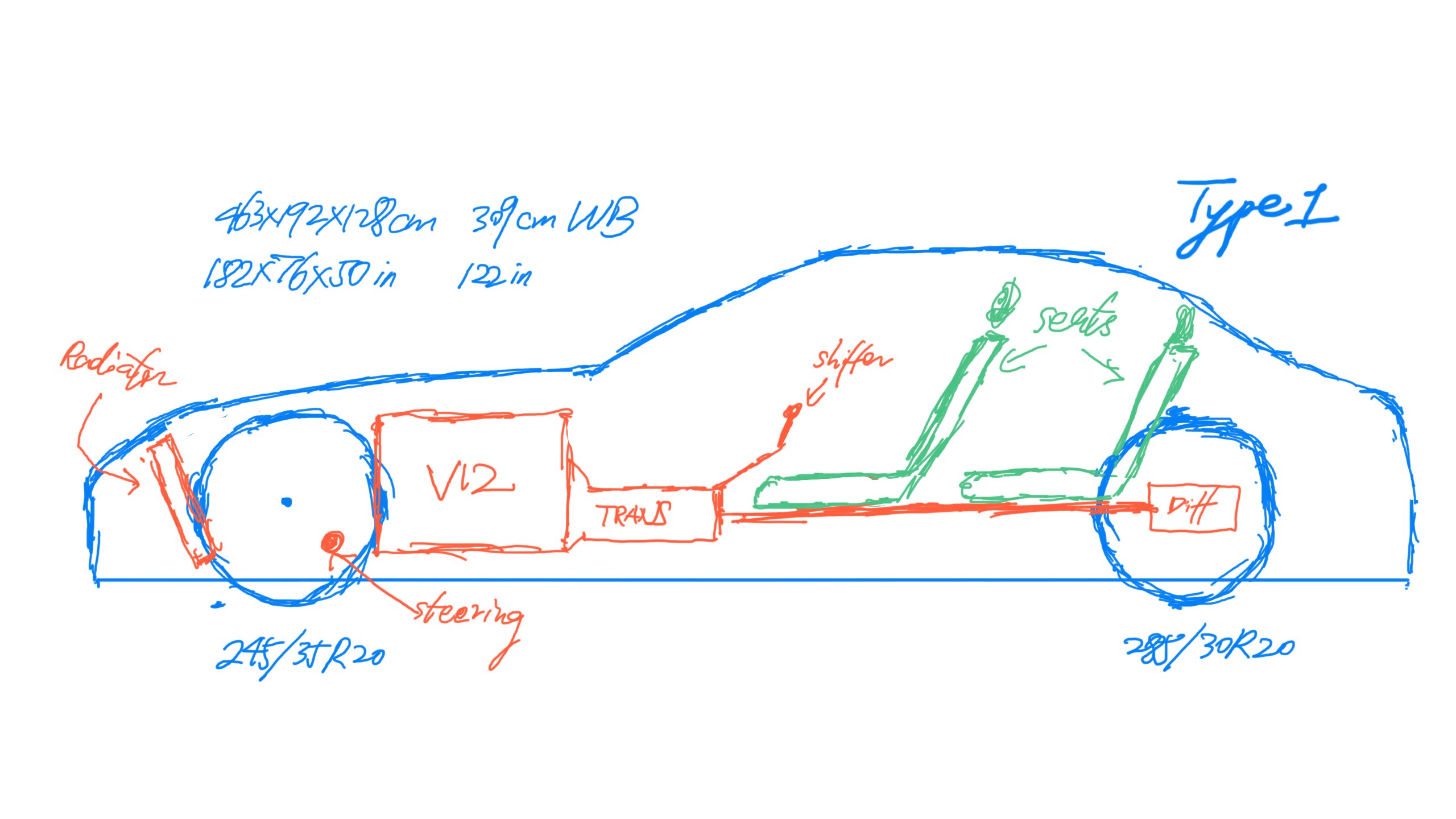
Type 1 measures 463cm long, 192cm wide, and 128cm tall, including a 10cm ground clearance. It has small front and rear overhangs, resulting in a 309cm wheelbase. The base of the windshield starts at 177cm. The front tyres are 245/35R20 on 20x9in wheels, and the rear 285/30R20 on 20x10.5in wheels. Therefore, these wheels measure roughly 68cm in height. Their outer edges are inset by 3mm and 2mm from the side panels respectively; this is to ensure that wheels do not protrude under compression. I will delve into the exterior design in a future post.
With these dimensions, Type 1 has a reasonably long engine compartment. Since our small-displacement V12 is very short, it can be installed entirely behind the front wheel arches. Thus, we will have an easy time with cooling and accessories, and the car can easily exceed vehicle safety requirements. At the same time, there is still enough room for rear seats, giving us a true 2+2 GT.
Naturally, this leaves us with a front-mid engine rear-wheel drive layout in its purest form.
Next Up
In the next post, I will discuss the chassis and suspension of Type 1.