techXXX
Understanding the Mercedes 722.3 / 722.4 / W4A Automatic Transmission (4G-Tronic)
Mercedes 722.3 is a hydraulically-controlled 4-speed automatic transmission. Today, let us check out not only how its gear train works but also how its hydraulic control functions.
Published by Dr Jiulin Teng on 30 Aug 2026
Keywords: mercedestransmission
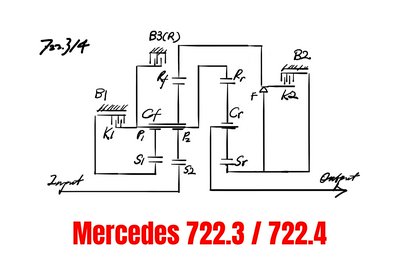
Mercedes 722.3 is a hydraulically-controlled 4-speed automatic transmission. Enthusiasts widely consider it to be the most reliable automatic ever produced by the company. It is mechanically simple and easy to rebuild. Today, let us check out not only how its gear train works but also how its hydraulic control functions—as one of the last non-electronically-controlled automatic transmissions designed, it represents the pinnacle of how hydraulic control works. I should note that the 722.4 is a light-duty variant of the 722.3, while the 722.5 is the 722.3 with an add-on overdrive that is electronically controlled. Since the 722.3 is not an electronically-controlled transmission, it is technically wrong to refer to it as ‘4G-Tronic’.
Gear Train
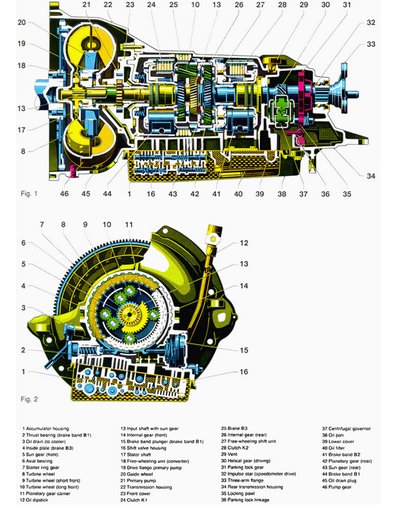
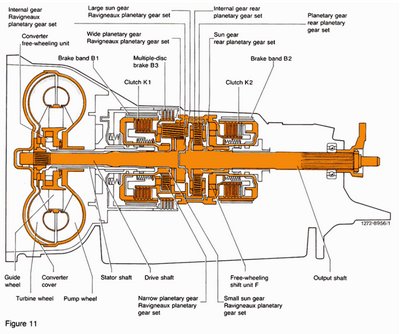
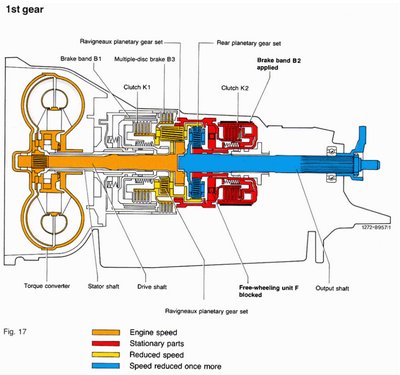
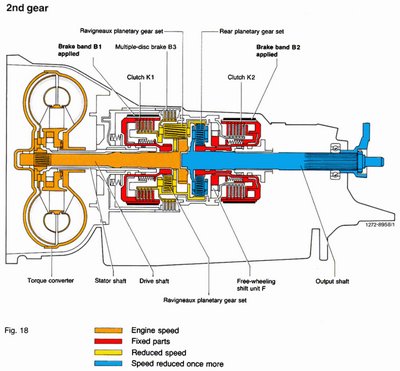
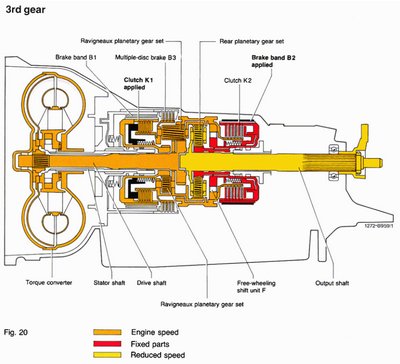
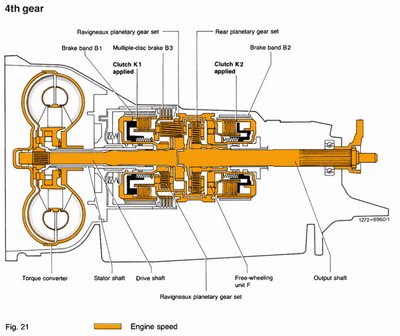
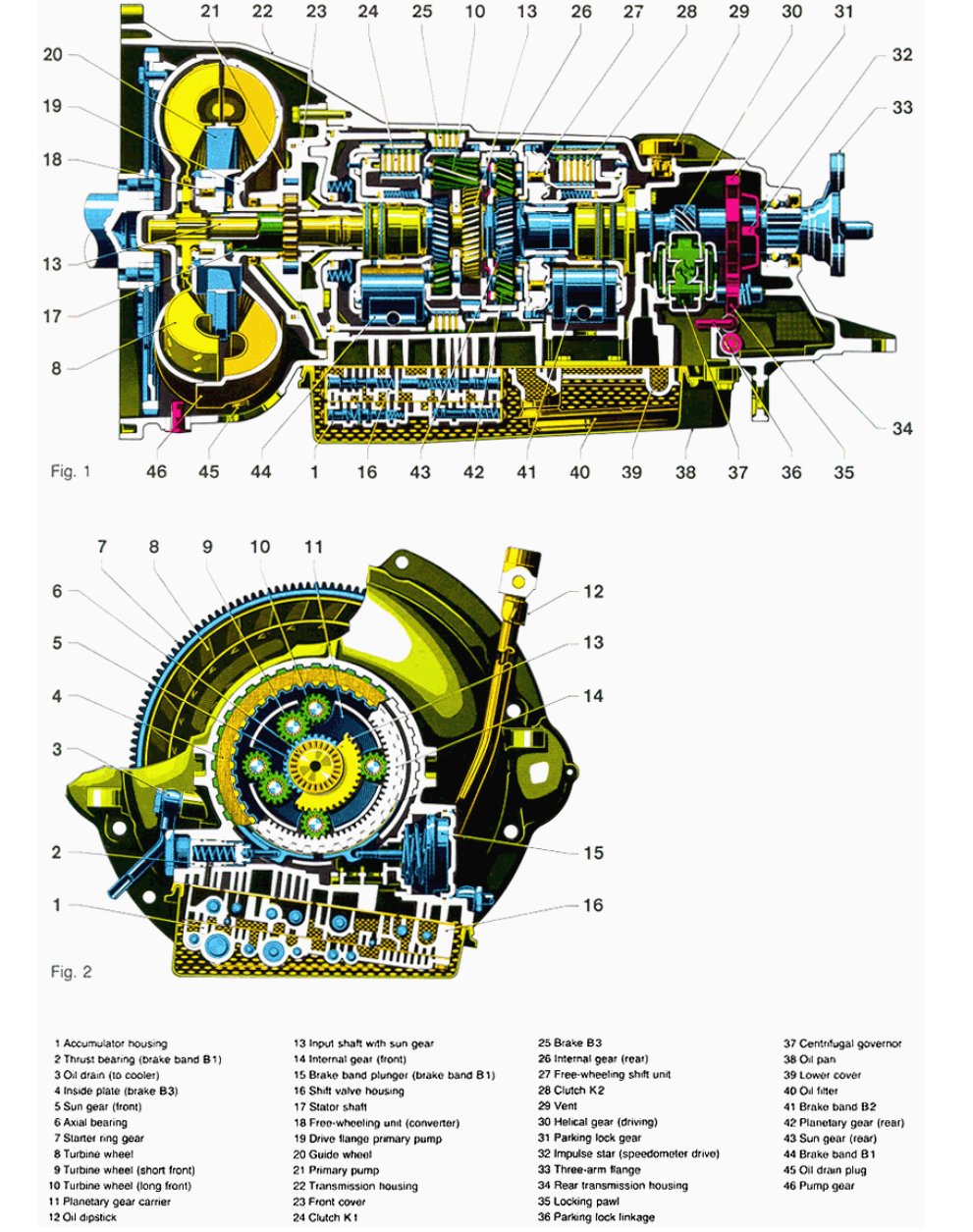
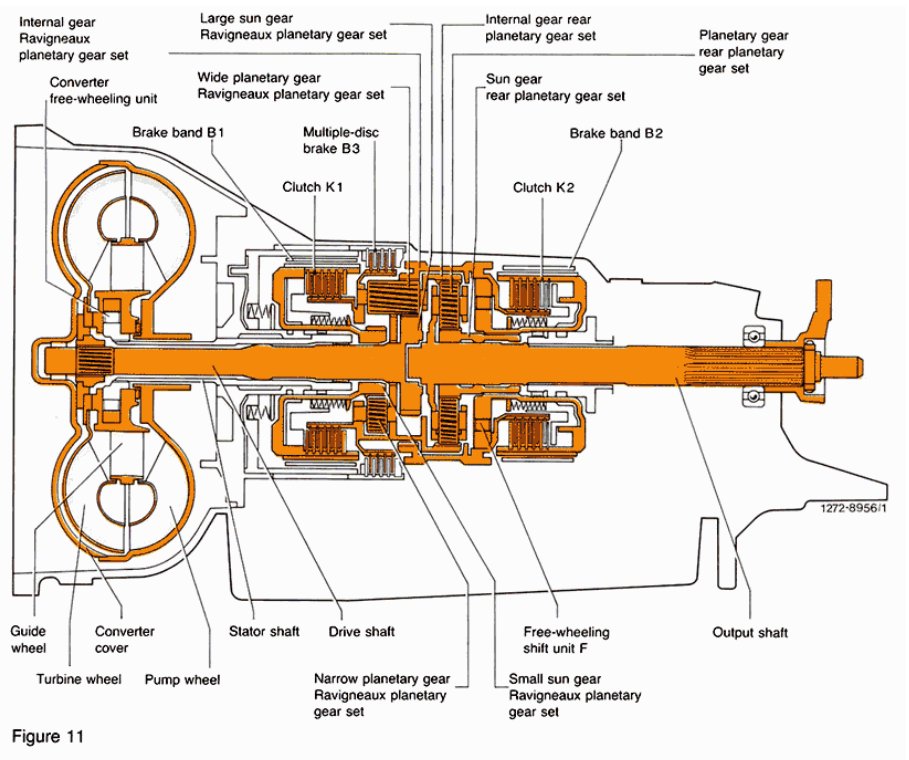
The 722.3 has two planetary gearsets, including a Ravigneaux gearset in the front. In this sense, it is similar to the ZF 6HP and Aisin AA80E, both of which offer a lot more gears. However, we need to keep in mind that until the 1990s having too many gears was considered a disadvantage, partly because hydraulic control made gear hunting a headache as the number of gears increased.
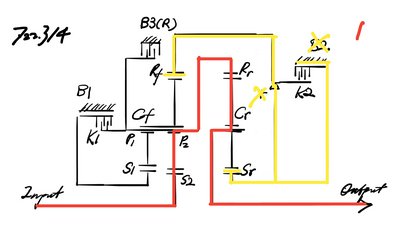
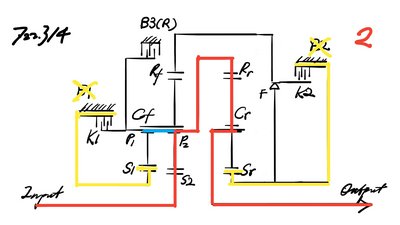
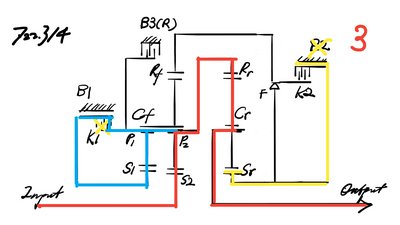
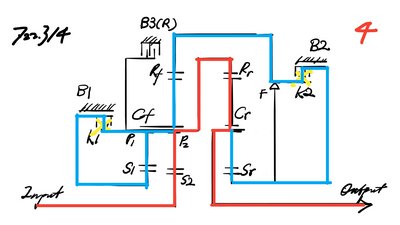
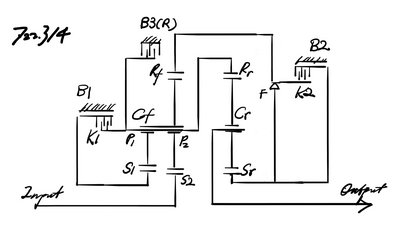
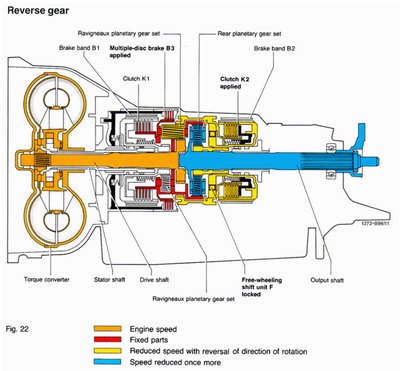
In the Ravigneaux gearset, the small sun gear in the front meshes with the short pinons, while the large sun gear in the back meshes with the long pinons. Only the long pinons mesh with the ring gear.
Other elements of this transmission include:
- Input via the large sun gear S2
- Output via the rear carrier Cr
- Cf front carrier permanently drive the rear ring gear Rr
- B1 brake band locks the small sun gear S1
- B2 brake band locks the rear sun gear Sr
- K1 clutch connects the small sun gear S1 to the front carrier Cf
- K2 clutch connects the front rear gear Rf to the rear sun gear Sr
- B3 brake locks the front carrier Cf
- F one-way clutch for the front ring gear Rf
Gears
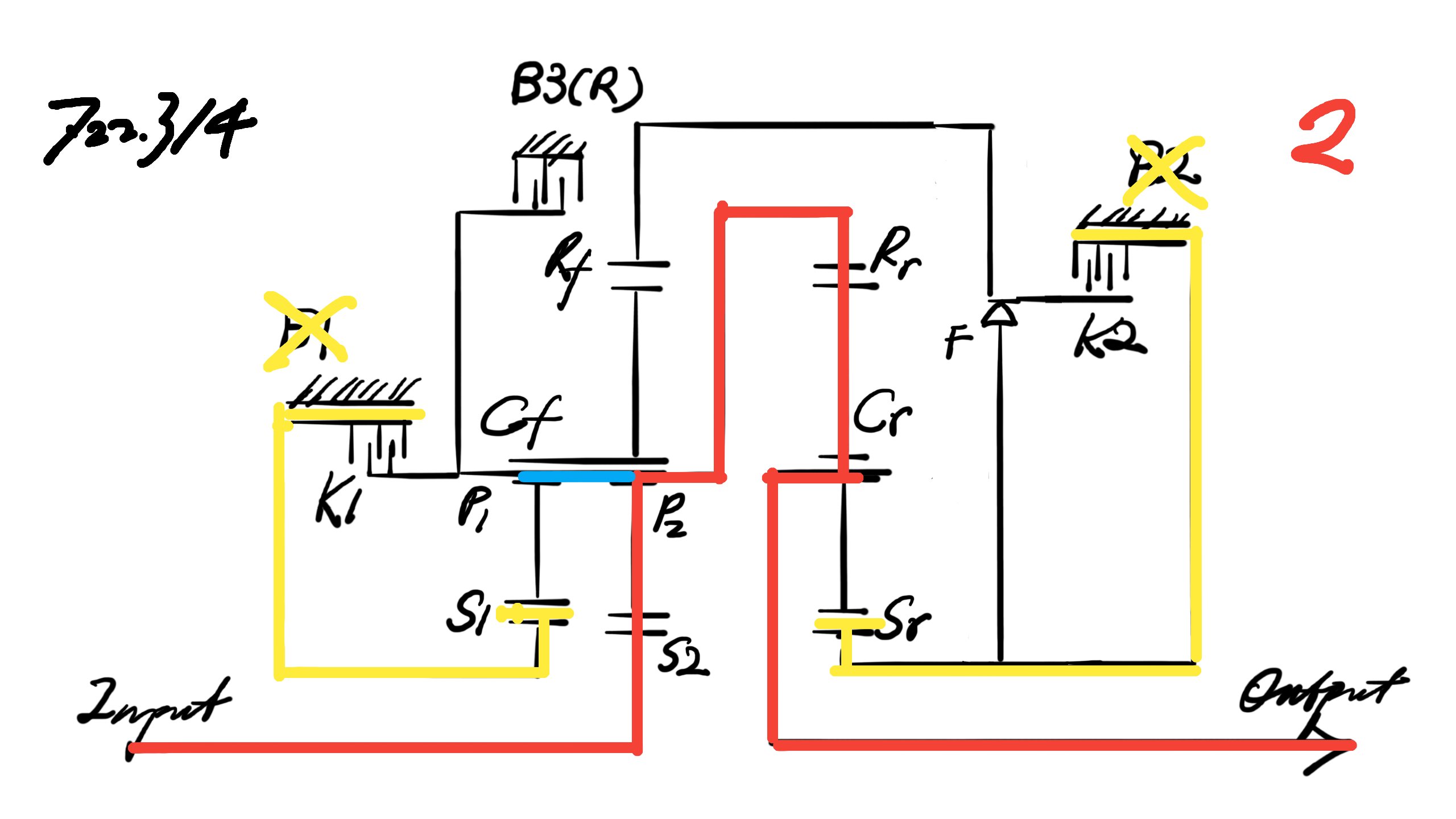
In 1st, B2 locks Sr and via F locks Rf. In the front, we have sun gear in, carrier out reduction. In the back, we have ring gear in, carrier out reduction.
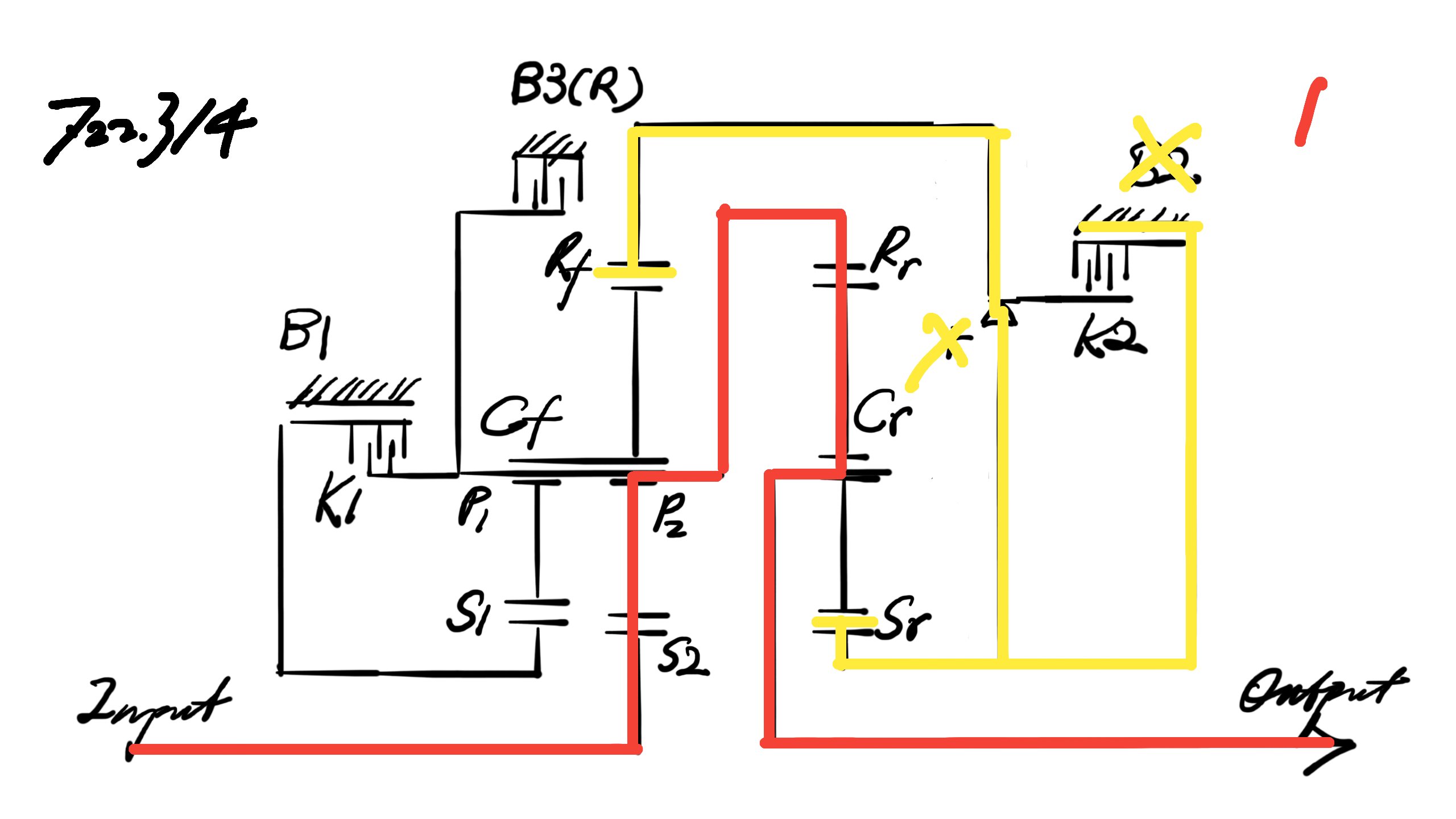
In 2nd, B1 locks S1, too. This is commonly how the 722.3 starts. In sudden acceleration or incline, it would unlock B1 and get 1st gear. In this situation, the front carrier Cf pivots on the small sun gear, and the ring gear Rf rotates without transmitting power. This reduction equals 1 + N_S1/N_S2. It is less than the 1st gear.
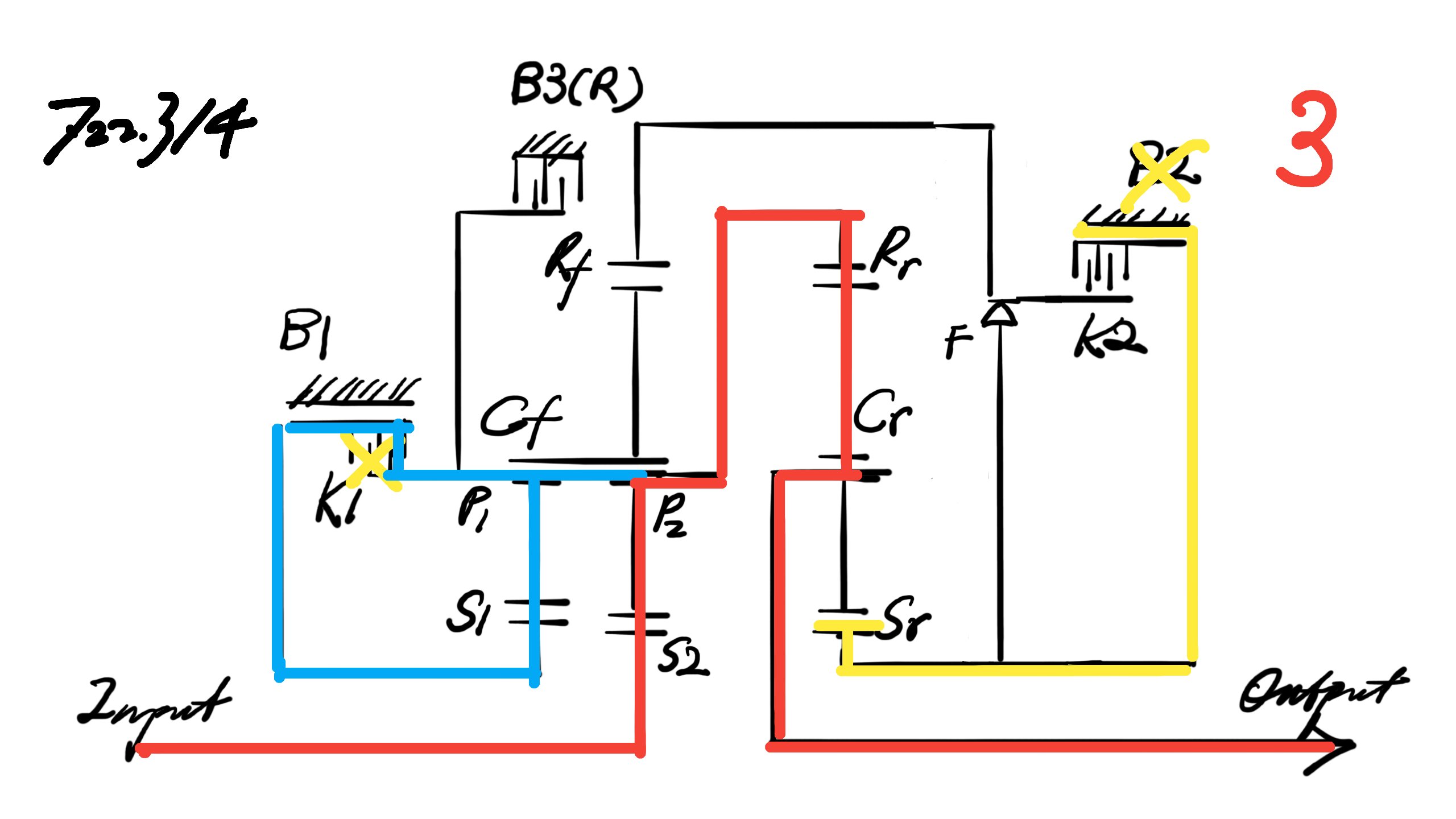
In 3rd, B1 is released while K1 is applied. This locks the Ravigneaux gearset as one unit. Reduction is only in the rear gearset.
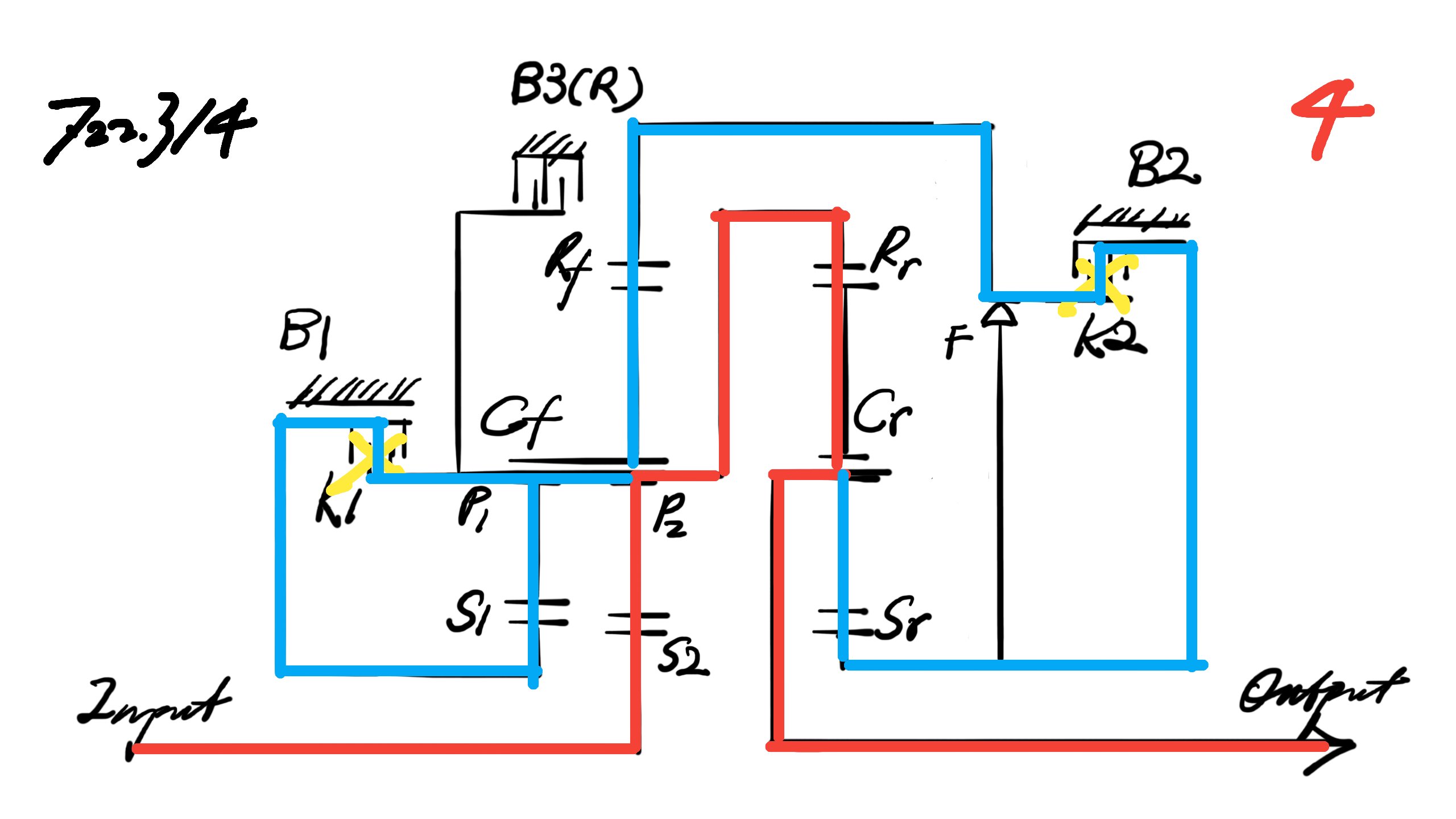
In 4th, B2 is released while K2 is applied. This also locks the rear gearset as one unit. Everything rotates at the input speed. This is direct drive.
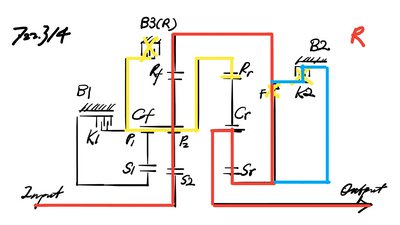
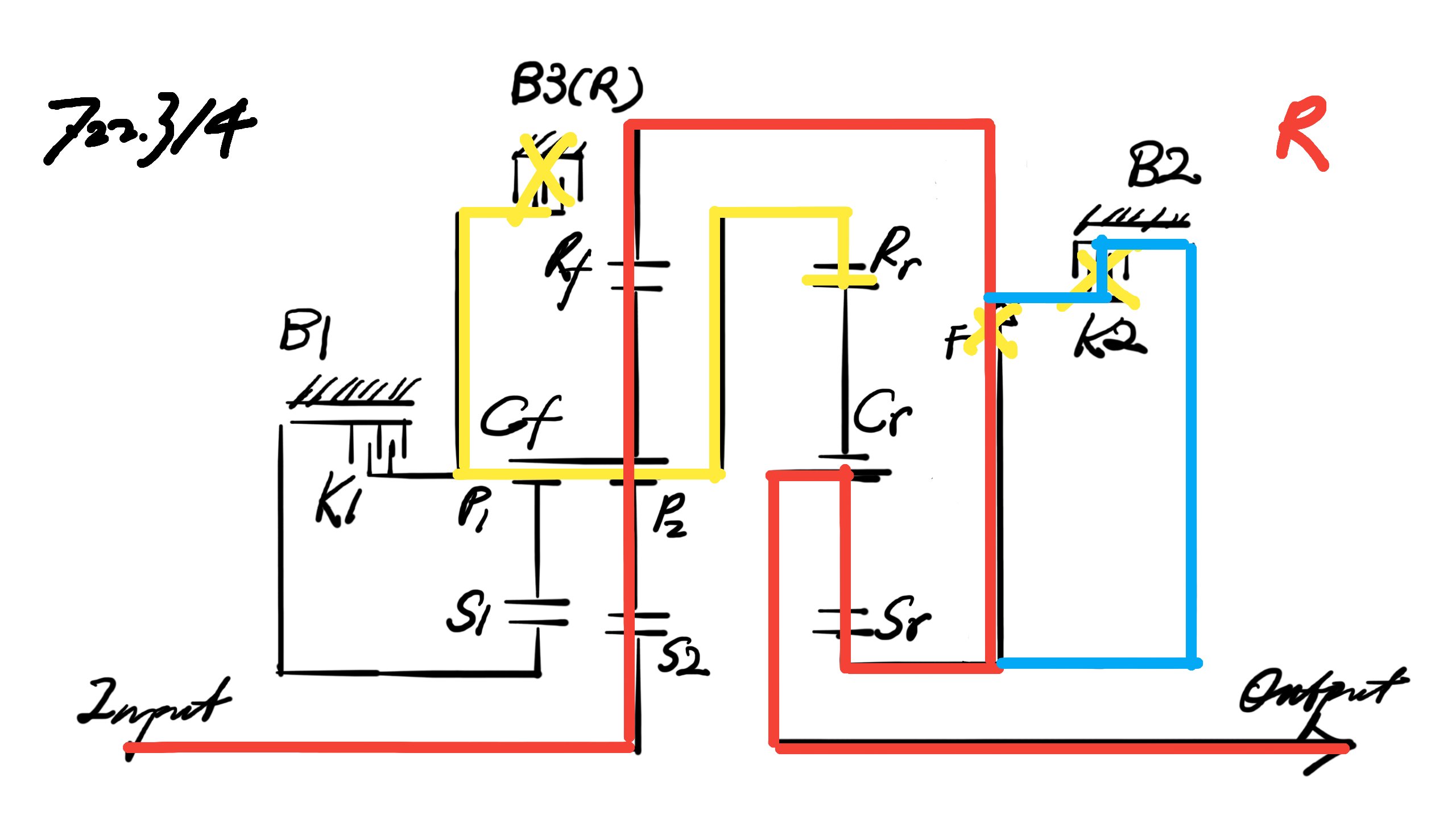
In reverse, B3 is applied, locking the front carrier Cf and the rear ring gear Rr. It transforms the Ravigneaux gearset into a simple gearset, allowing S1 to rotate freely. This also causes reversal from S2 to Rf as well as a reduction. The one-way clutch F sends power from Rf to Sr. K2 is also applied to avoid overrun. With Rr locked, we have another gear reduction in the form of sun gear in, carrier out.
Hydraulic Control
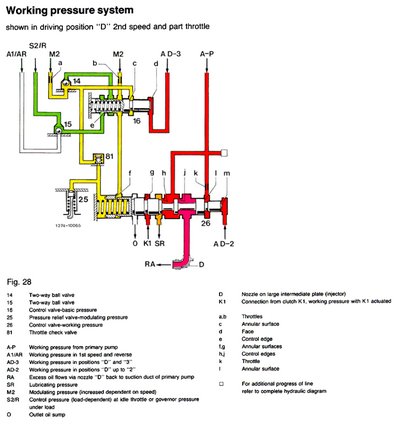
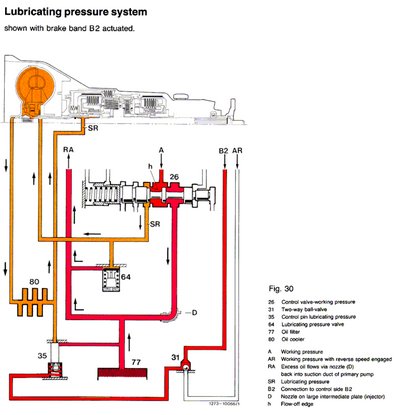
As a purely hydraulically-controlled transmission, the 722.3 has several hydraulic subsystems: working pressure system that regulates the actuation of the brakes and clutches, lubricating pressure system that limits the lubricating pressure, and modulating and control pressure systems that actually affect the shift points. The first two are intuitive to understand, and I encourage readers interested in this subject to read the Mercedes documentation.
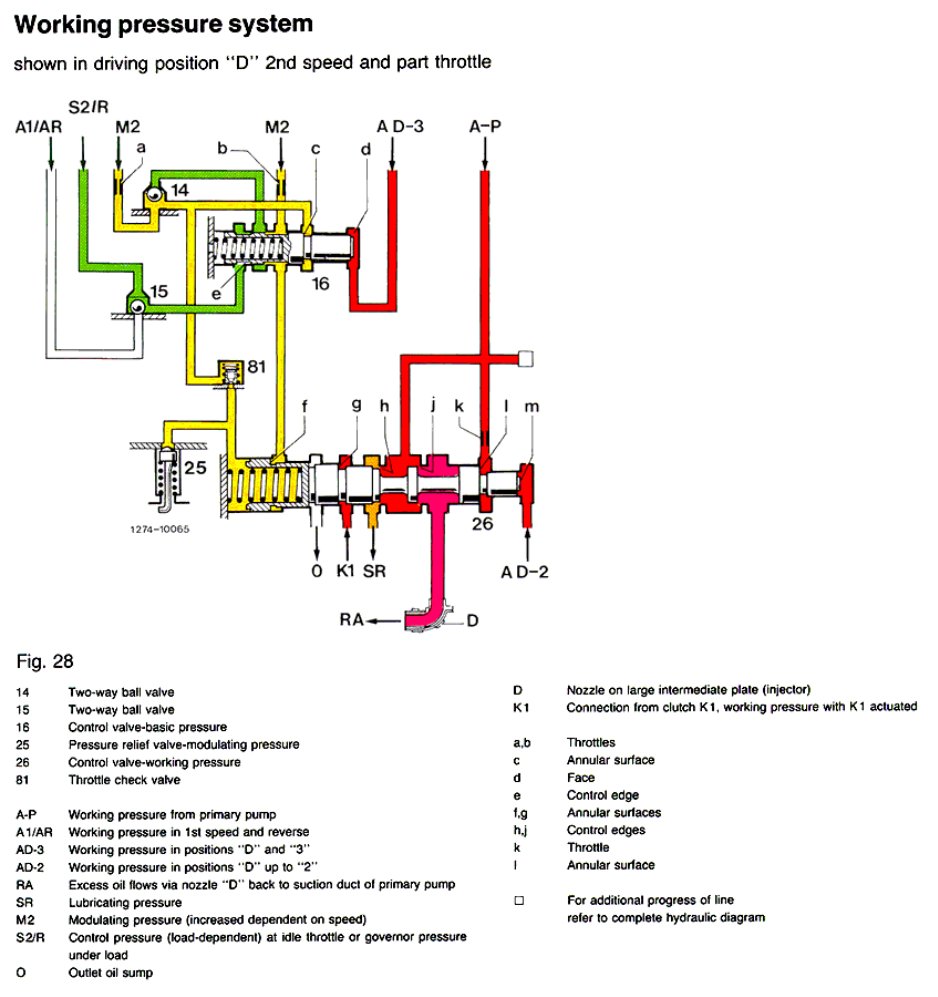
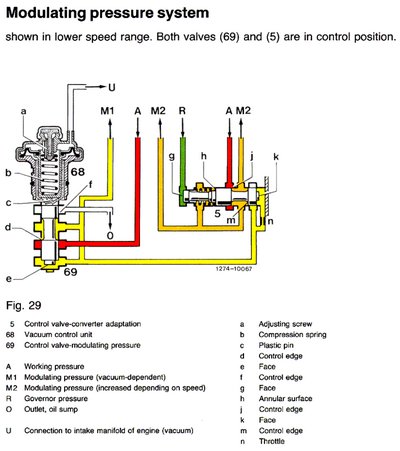
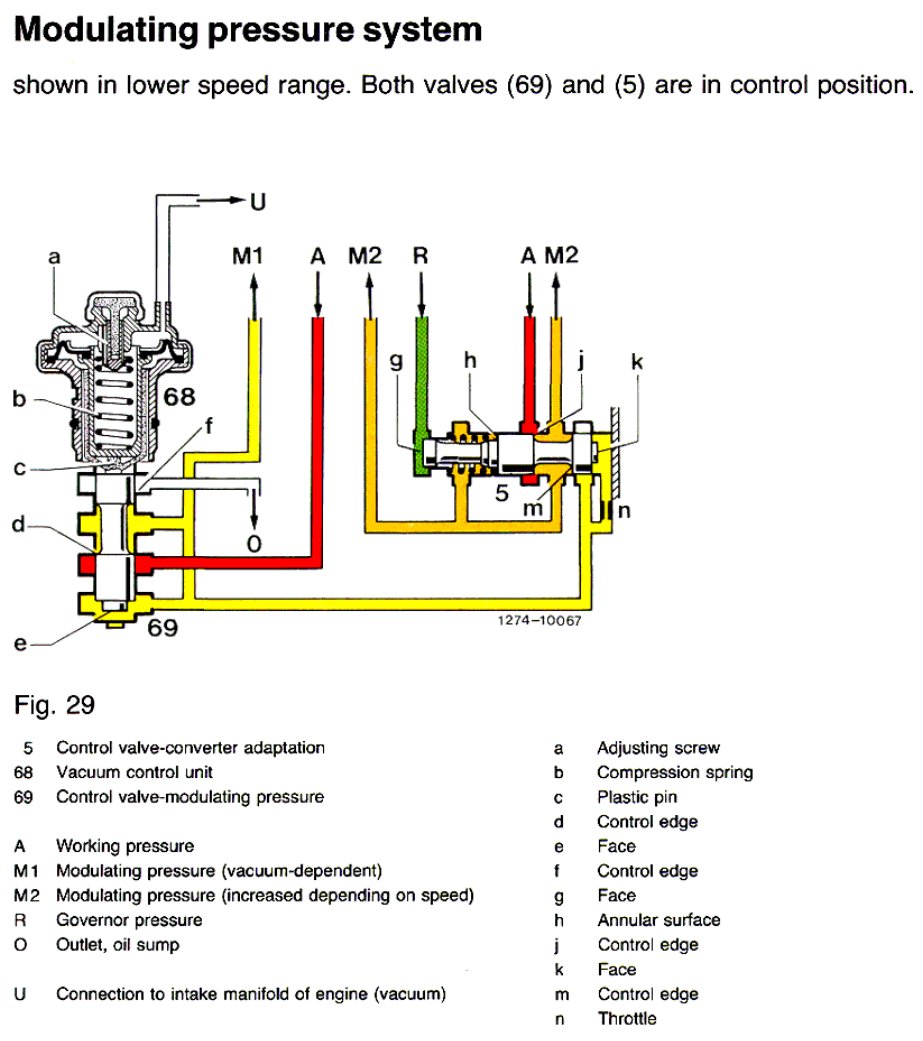
The modulating pressures M1 and M2 are the main sources that determine the shift points. M1 is inversely driven by engine vacuum; it commands delayed upshift or a downshift. M2 is generated by the centrifugal governor and correlates with output shaft speed; it commands upshift or delayed downshift. As engine load increases, vacuum drops, this increases M1; as speed builds up, M2 increases. The balance of the two modulating pressures drives gear changes. M1 also modulates the shift pressure. Higher M1 increases shift pressure for a firmer gear change.
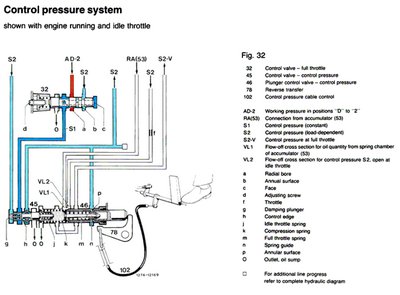
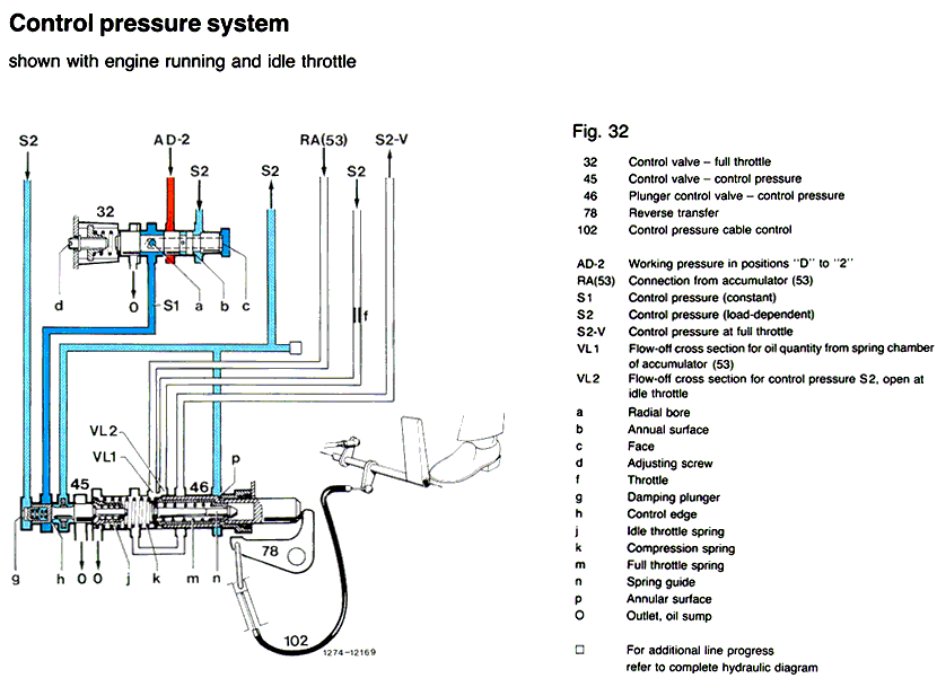
Additionally, M2 is affected by the position of the accelerator pedal in the form of control pressures:
- Control pressure S1 is a constant pressure that can be adjusted by a screw. At full throttle or when kickdown is activated, it reduces the effect of M2.
- Control pressure S2 is fed by S1 and reduces the effect of M2 gradually as the throttle gets opened more.
- Control pressure S3 is the kickdown pressure that further reduces the effect of M2 to force a downshift.
Actual gearshifts are managed by a series of shift valves that incorporate these pressures. While hydraulic control seems foreign to most today, its working principles are rather simple. Later electronically-controlled automatic transmissions continued to incorporate some of these principles, even though sensors replaced engine vacuum, centrifugal governor, and others. Only transmissions introduced well into the 2000s became almost entirely electronically-controlled.
Gallery: Mercedes 722.3
XXX