techXXX
Ford 10R–GM 10L 10-Speed Automatic Transmission Deep Dive (10R80 / 10L80 and variants)
The Ford-GM 10-speed is an evolution of the ZF 8HP that doubles down on the original’s gear train design and philosophy. Today, let us analyze its advantages and trade-offs and delve into how its gear train works.
Published by Dr Jiulin Teng on 07 Jan 2026
Reportedly costing $1 billion to develop, the Ford 10R / GM 10L is arguably the world’s most advanced automatic transmission for passenger vehicles. It is an evolution of the ZF 8HP that doubles down on the original’s gear train design and philosophy. Today, let us analyze its advantages and trade-offs and delve into how its gear train works.
Advantages
1. Crisp, Dynamic Gear Changes. The primary goal of Ford was to have an efficient transmission that is engaging for the driver. The 10R–10L doubled down on speed compared to the ZF 8HP, which is made possible by the smaller gear steps.
2. Only Two Friction Elements Open. On the efficiency front, this transmission keeps only two friction elements open in most forward gears, even though it has an additional clutch pack compared to the ZF 8HP.
3. Gear-Driven Oil Pump. While the ZF design used a chain-driven oil pump, Ford uses a gear-driven one. This helps reduce axil length without an extra point of failure.
4. High Scalability. The 10R–10L transmission family is highly scalable. Ford and GM have scaled it up and down to use it with small petrol engines and large diesels alike.
5. Non-Sequential Upshifts. One concept that Ford introduced is the non-sequential upshift strategy. Normally, modern transmissions can downshift over multiple gears when only two shift elements are involved. The 10R 80 can do the same in upshifts such as 3–5, 4–6, and 5–7, etc. This is made possible by careful designs that require single clutch-to-clutch actions in both single and double upshifts. However, I should point out that drivers seem to dislike it vehemently, and Ford has been gradually programming this feature out.
Trade-Offs
1. Fragile Drums. As an evolution of the ZF 8HP, the 10R–10L transmission family inherited the multiple oversized drums, which are not present in the Mercedes or Toyota / Aisin designs. Two issues have already bit Ford and GM: One is the C-D-F drum, which is the innovation that has made the 10-speed possible, in how it holds its bushings. Of course, in a robust design, this drum would not be here, and any small drums that hold clutch packs would use roller bearings. The other is the large outer drum that connects Gearsets 1 and 4. While fragile to begin with, Ford has added Clutch F to the middle of it. This is one double-down on the ZF 8HP that went too far.
2. Clutch-Intense Power Paths. While old, robust designs such as the Mercedes 7G-Tronic avoided heavy use of clutches to transmit power, the 10R–10L doubles down on ZF’s design philosophy and uses its clutches aggressively. Because friction material wears much faster than gears, this type of design does not age as gracefully.
3. Calibration Issues. Trying to balance fuel economy and drivability in an automatic transmission is hard, especially with this many gears and the option to skip gears. This has not been perfected.
4. Uneven Gear Spread. Unlike the Aisin AWR10L65, which I covered previously, this transmission also doubled down on the ZF 8HP’s gear spread issue. Gear steps fluctuate, which prevents the 10R–10L from delivering what Toyota calls “rhythmical shifts”.
Gear Train
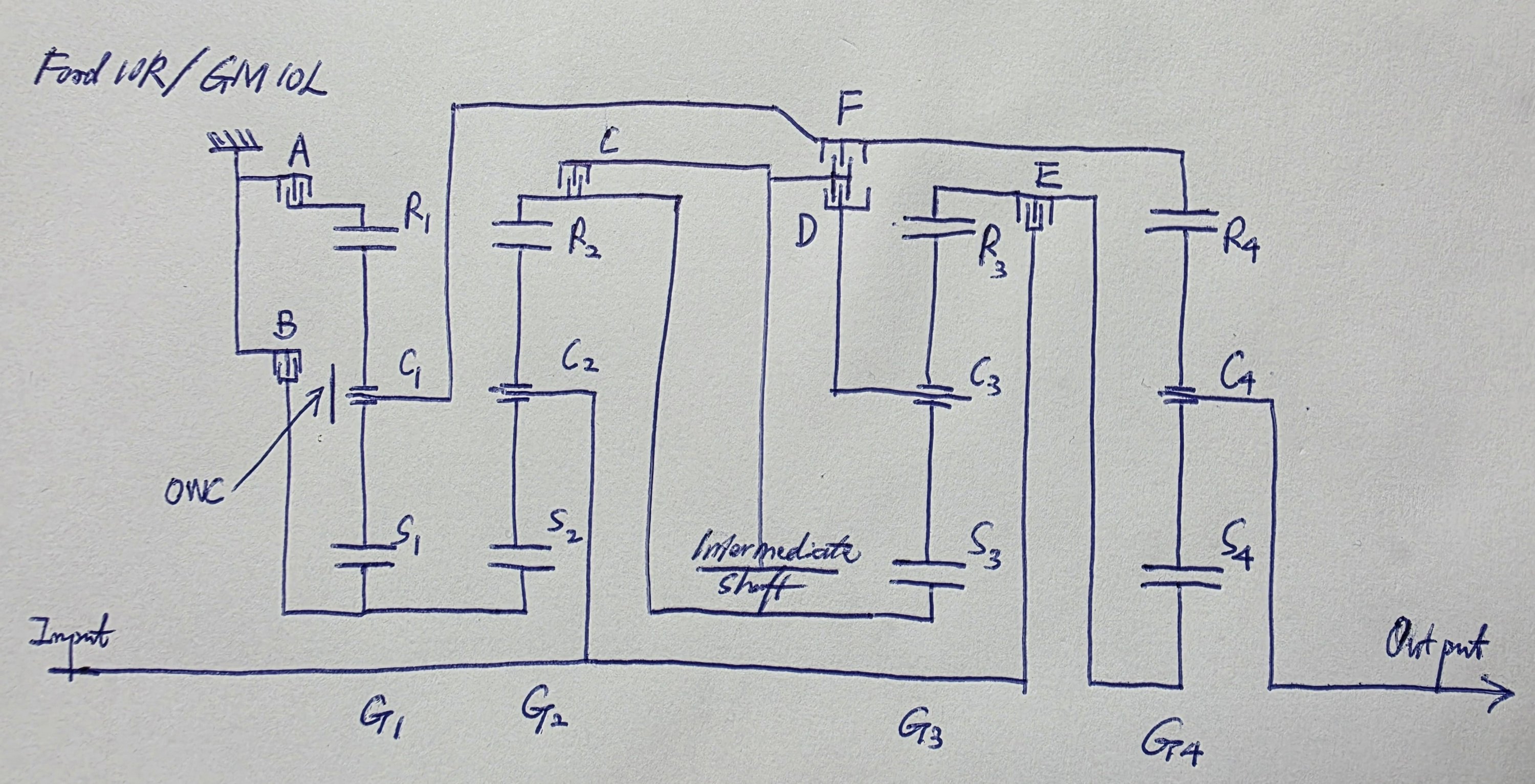
Now moving onto the gear train. This Ford design is clearly Inspired by the ZF 8HP. However, it is unfair to say that it is based on the latter. In this schematic that I drew, A and B are the brakes; C, D, E, and F are the clutches. There are four planetary gearsets, each with its sun gear, carrier, and ring gear marked out as Sx, Cx, and Rx. There is also a one-way clutch on C1. One point is worth noting:
The ZF 8HP would have just engaged Clutch B instead of installing the OWC. This Ford design allows shifting between Neutral and Drive to be achieved with a single clutch-to-clutch action. While I have not accessed Ford’s documentation, I suspect this transmission goes into neutral while stopped to save fuel.
Torque Paths
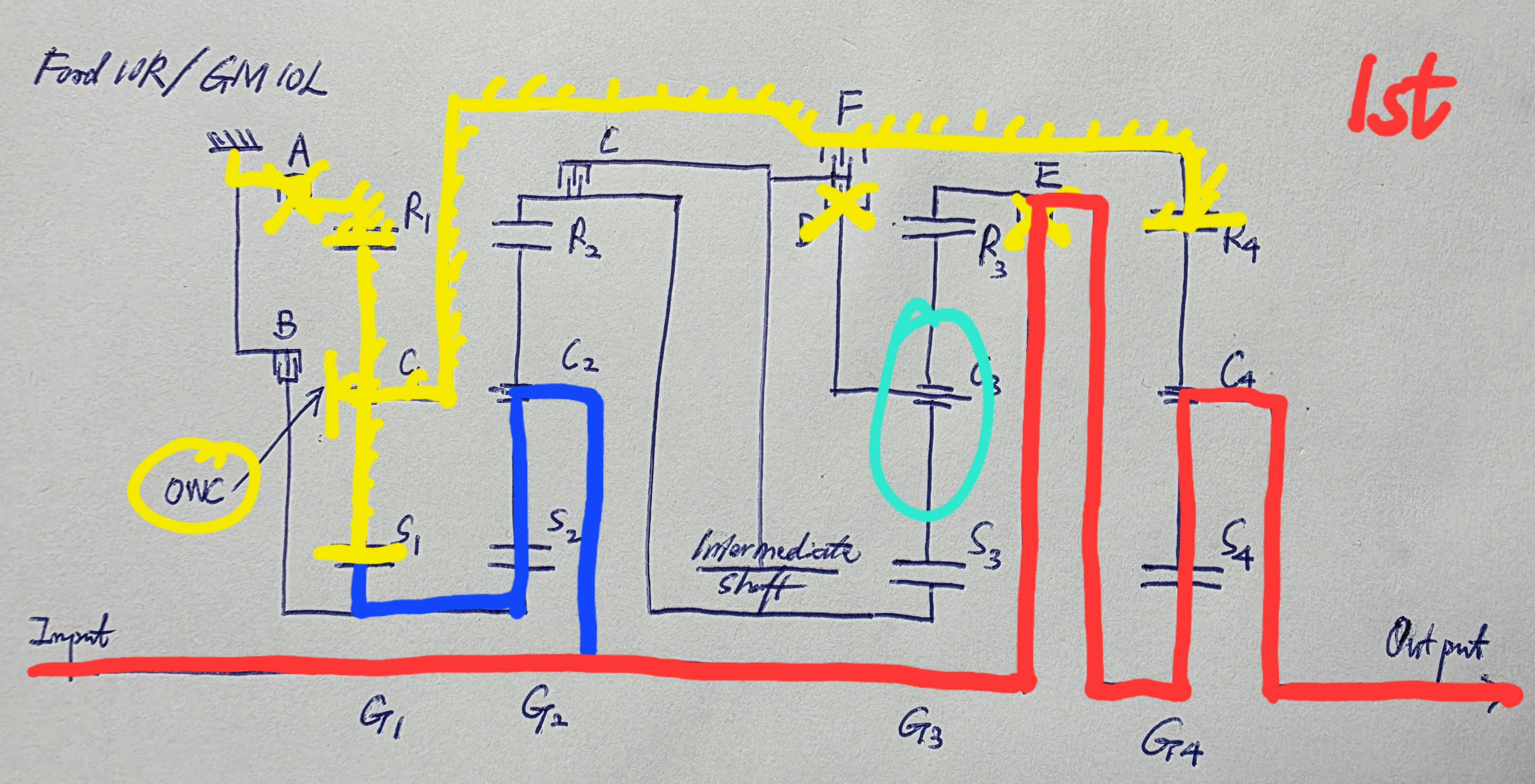
In 1st, torque goes through E > S4 > C4. The one-way clutch with the help of input from C2 > S2 > S1 holds C1 and thereby R4 still. Speed reduction happens in G4.
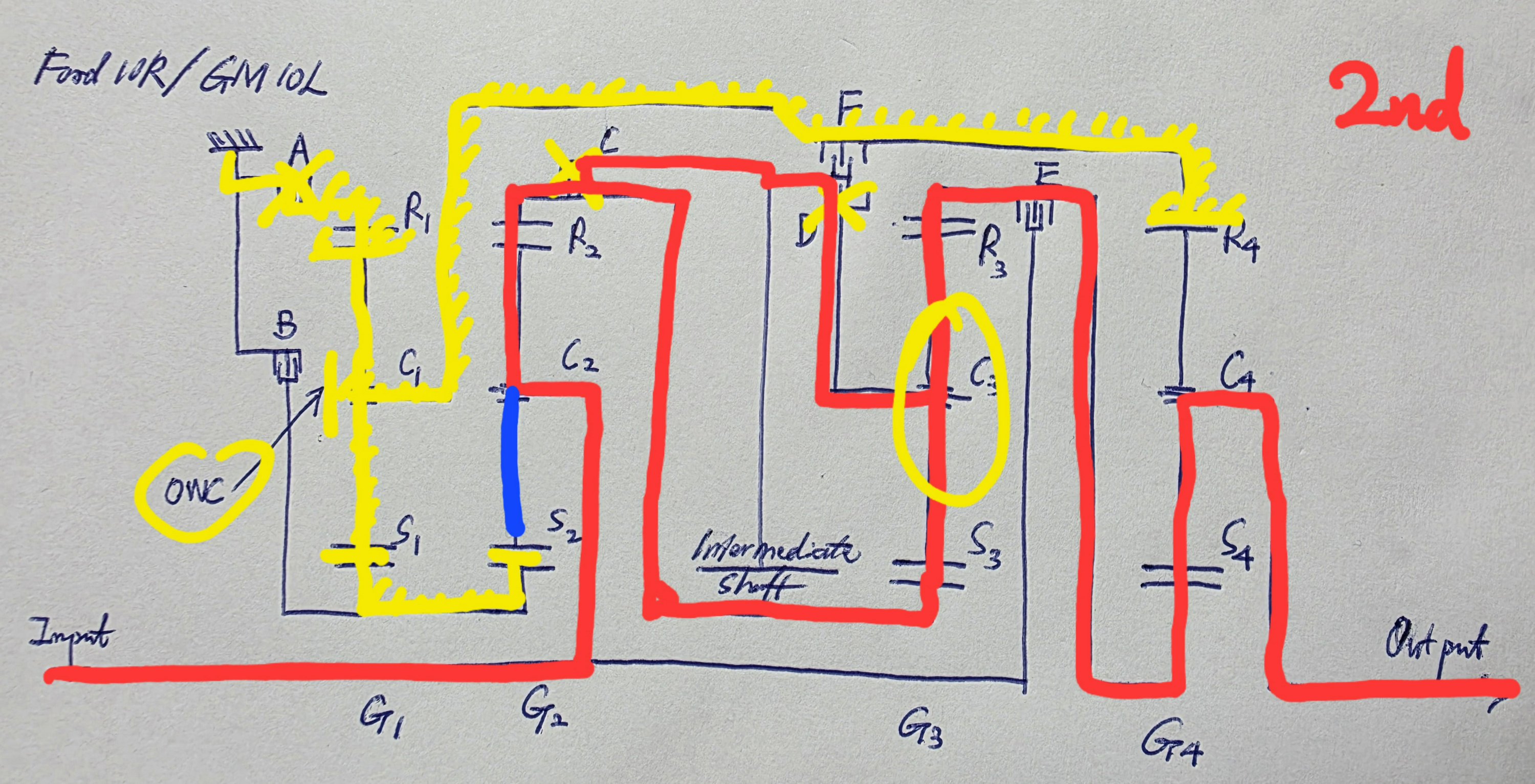
In 2nd, torque goes through C2 > R2 > S3 > C3 > R3 > S4 > C4, with a parallel path of R2 > C > D > C3. This locks G3 as a unit. Speed increases in G2 but reduces in G4.
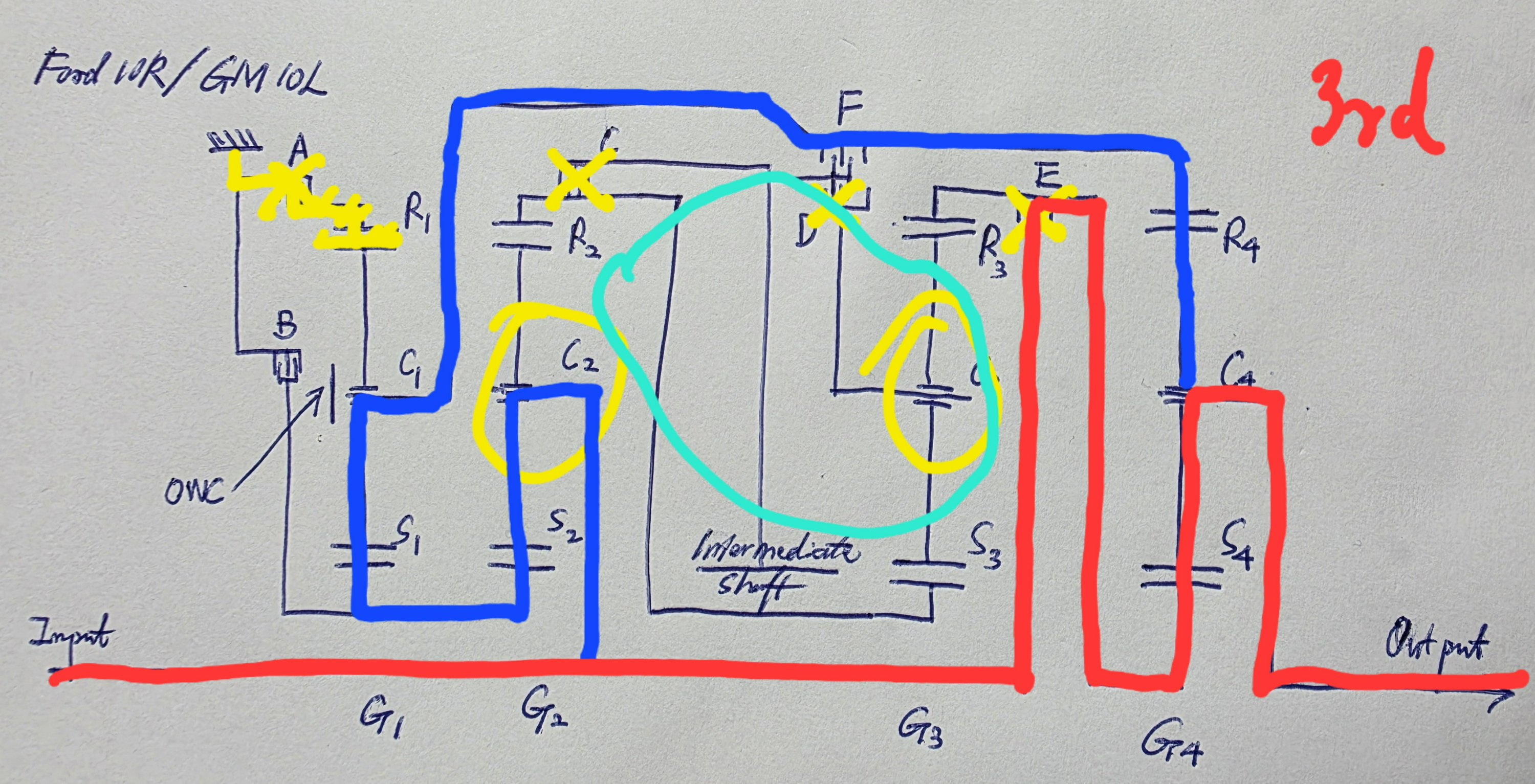
In 3rd, torque goes through E > S4 > C4. Restraining is C2 > S2 > S1 > C1 > R4. Engaging C and D locks G3; further engaging E also locks G2. Thus, speed in the counter-holding path reduces only in G1. Overall, speed reduction happens in G4 for this gear.
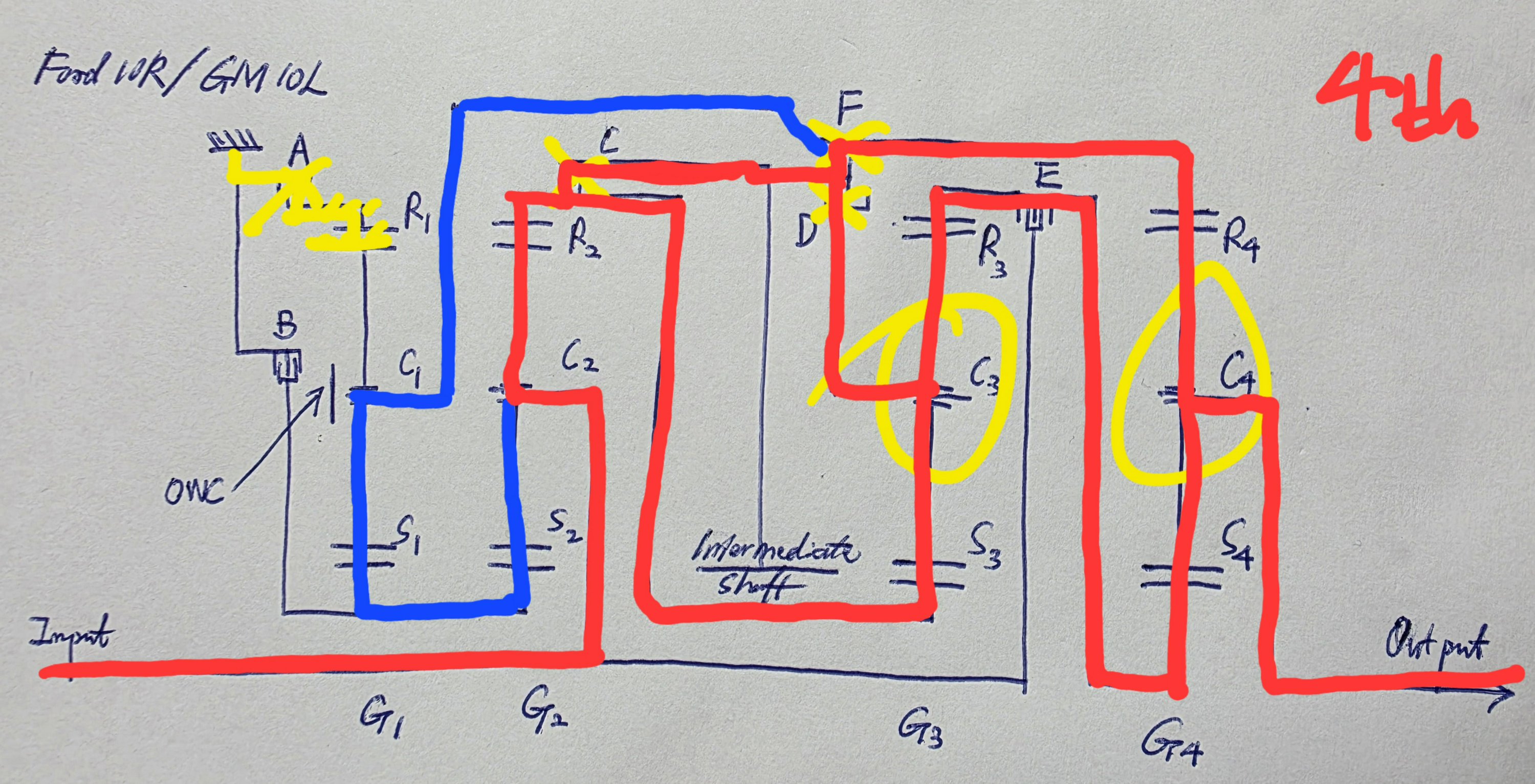
In 4th, torque goes through the many parallel paths as shown. Like in 3rd, engaging C and D locks G3. Further engaging F also locks G4. Thus, the only speed changes take place in the two front gearsets. G1 is the restraint, because engaging A slows C1 down.
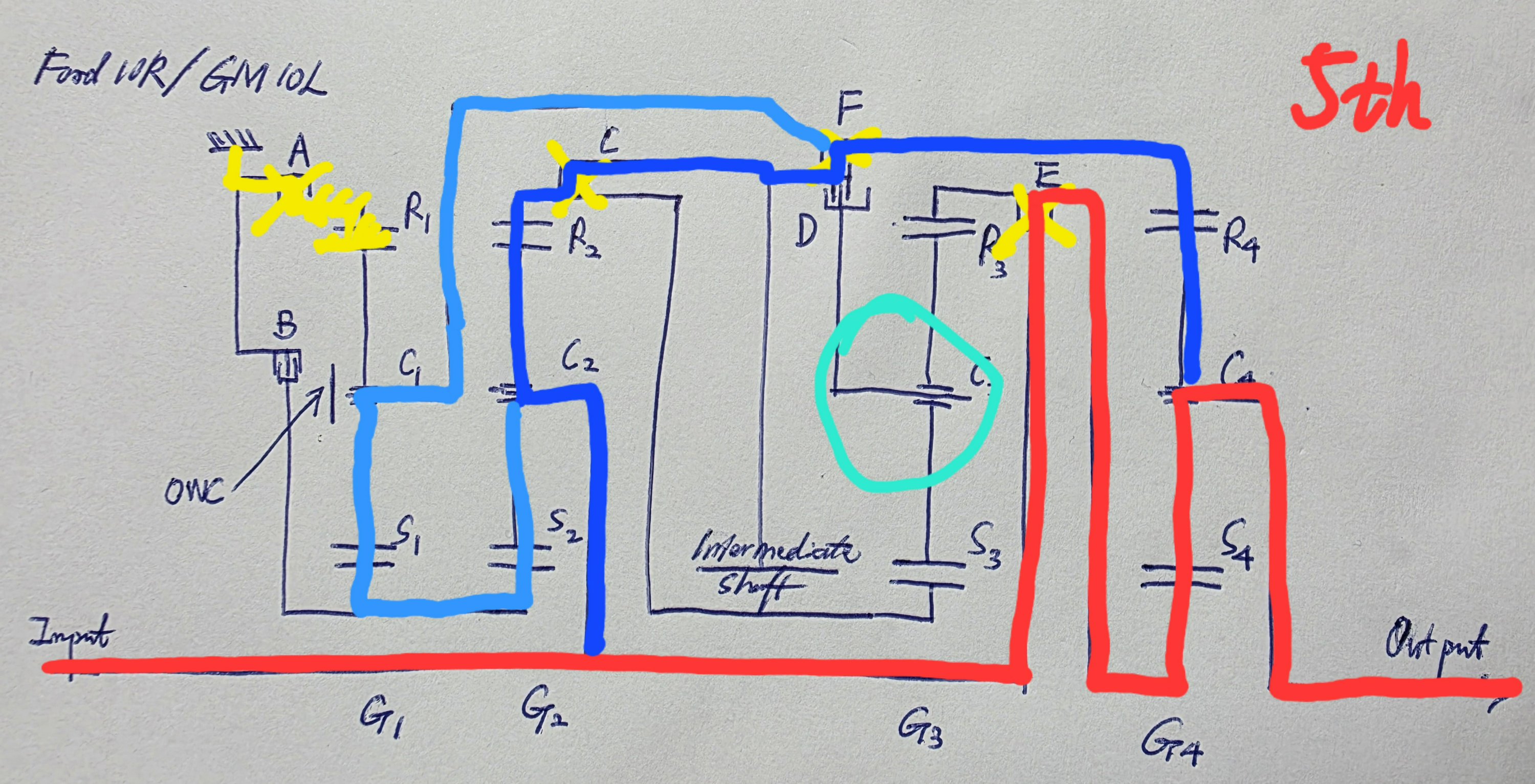
In 5th, torque goes through E > S4 > C4. Restraining is C2 > R2 > C > F > R4, which is restrained by S2 > S1 > C1. R4 is slower also because engaging A slows C1 down, as in 4th.
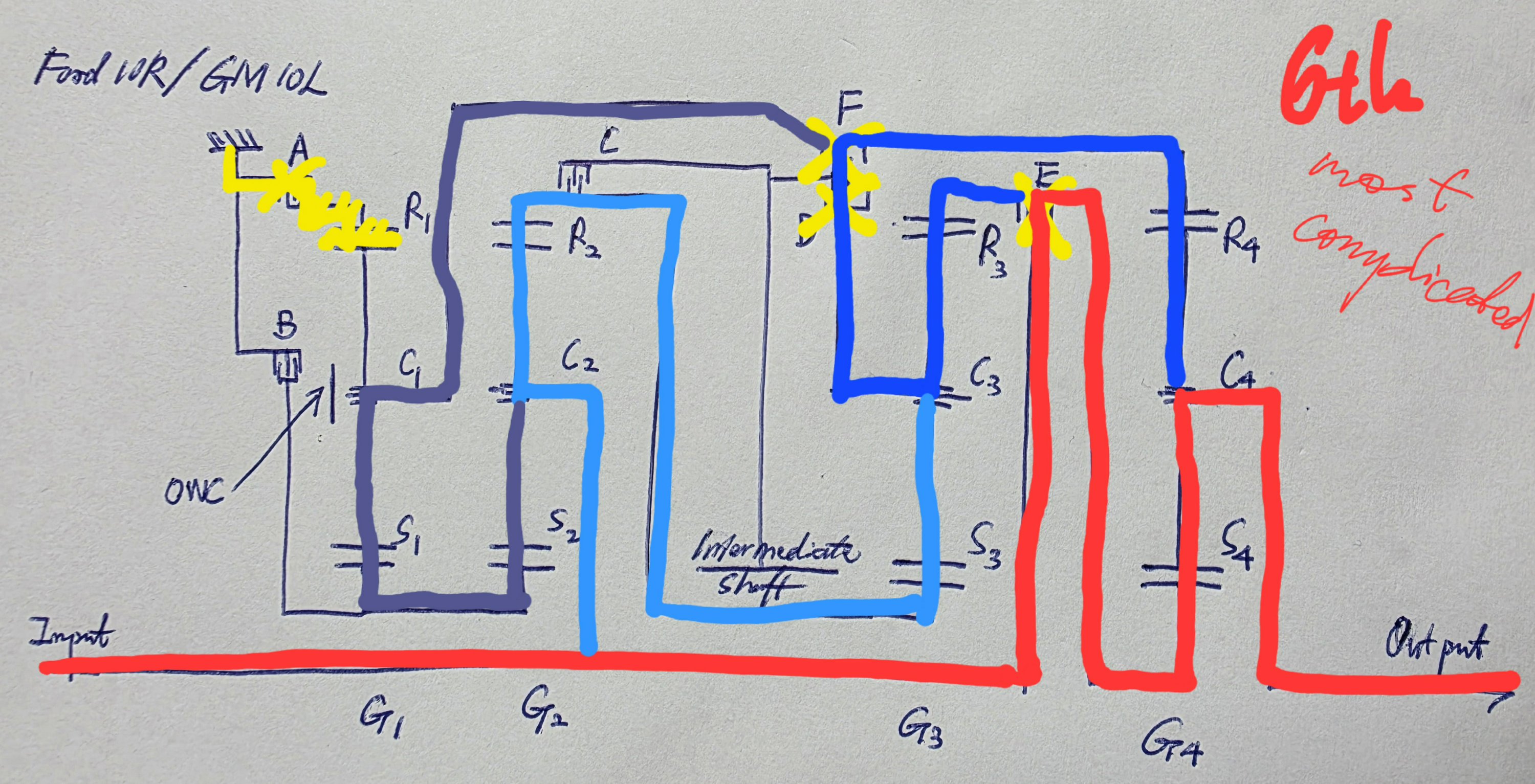
In 6th, torque goes through E > S4 > C4. Many paths act as restraints as shown. This is the most complicated gear. On a side note, looking at this here is when I remembered that my original analysis of the 5th in the ZF 8HP was wrong. You can check the updated version of my earlier blog post to see more details.

In 7th, the direct drive has several parallel paths. It is like 4th without engaging A, so everything rotates at the transmission input speed.
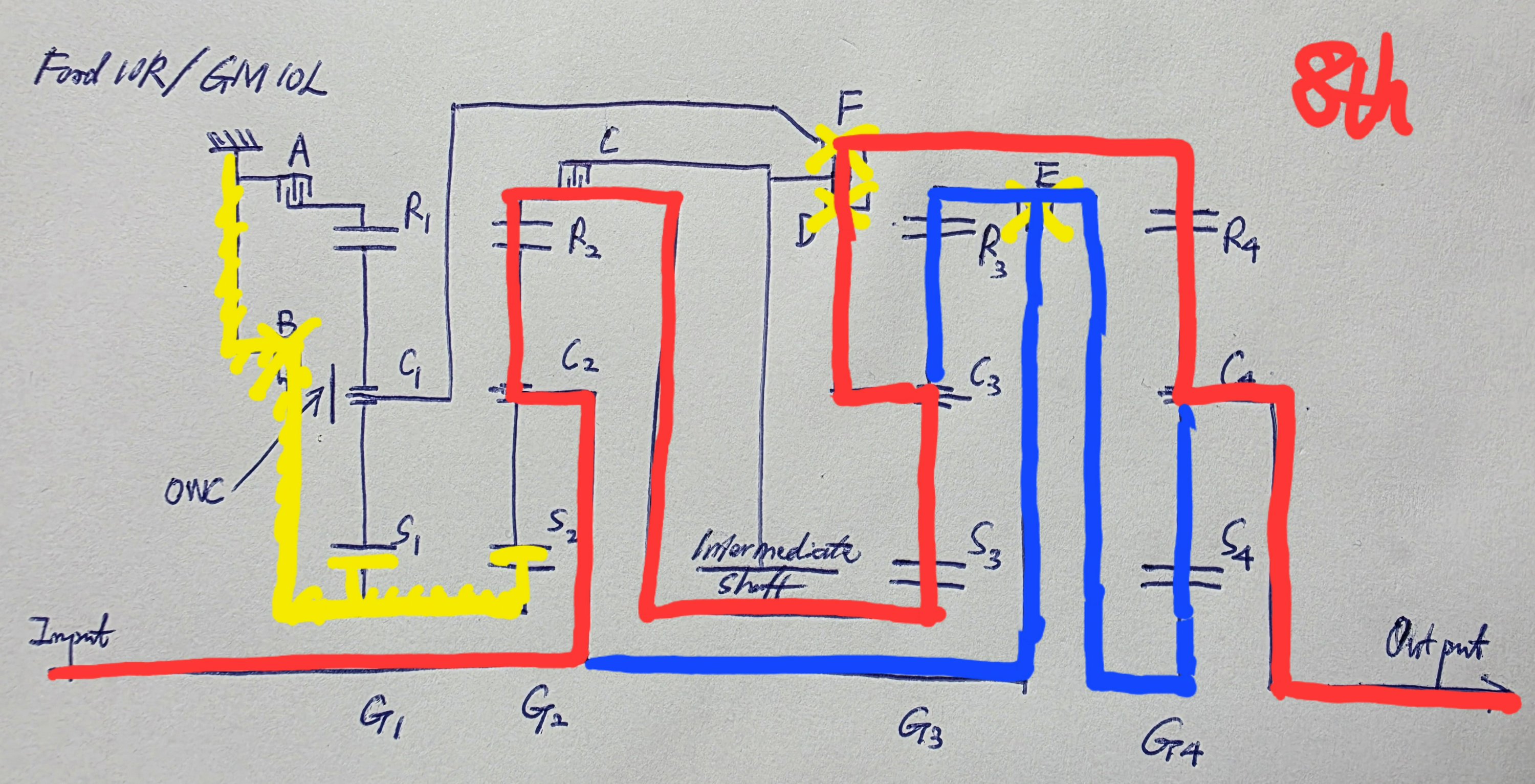
In 8th, torque goes through C2 > R2 > S3 > D > F > R4 > C4. Speed increases in G2 but is then reduced in G3 and G4.
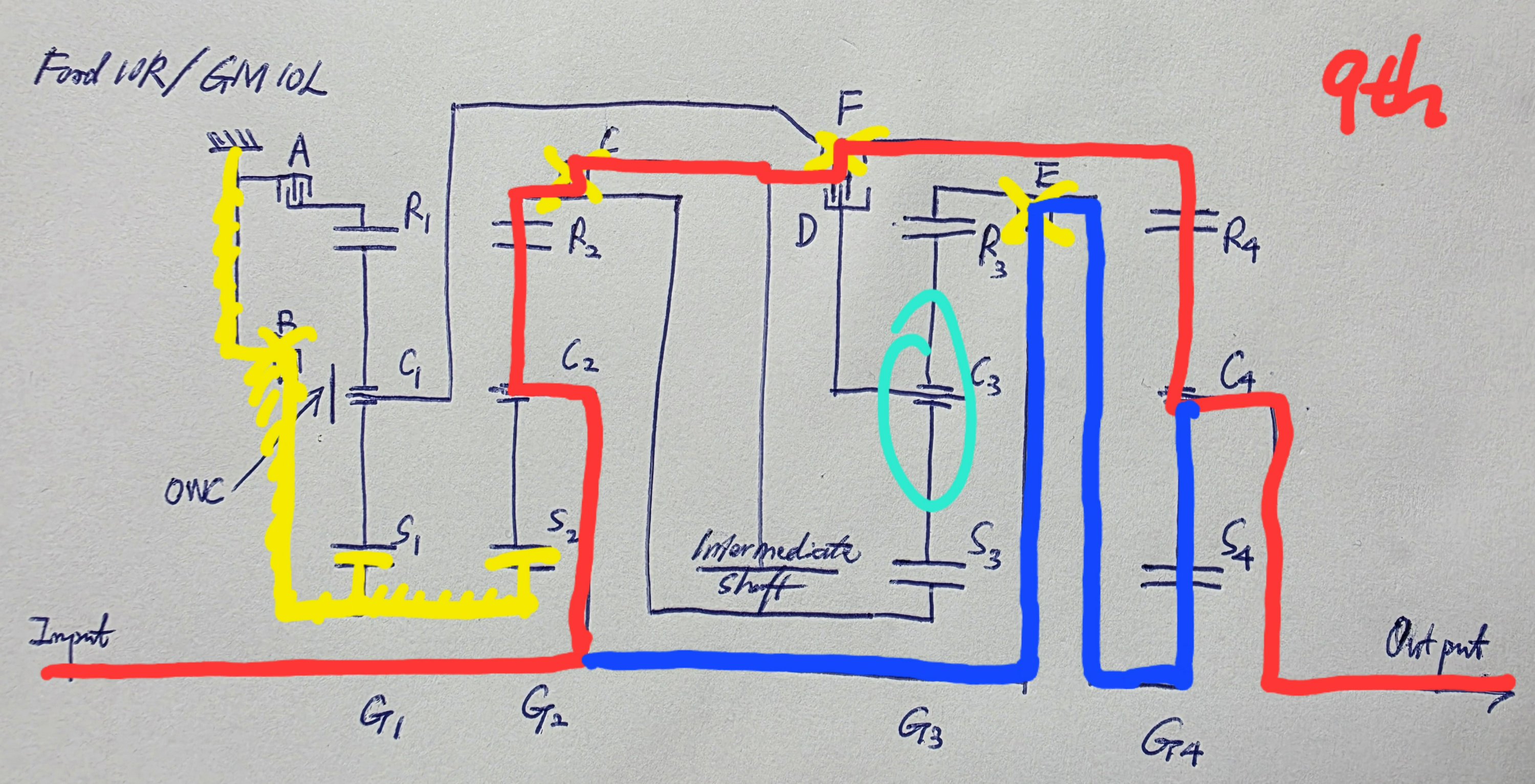
In 9th, torque goes through C2 > R2 > C > F > R4 > C4. Speed increases in G2 but is reduced in G4.
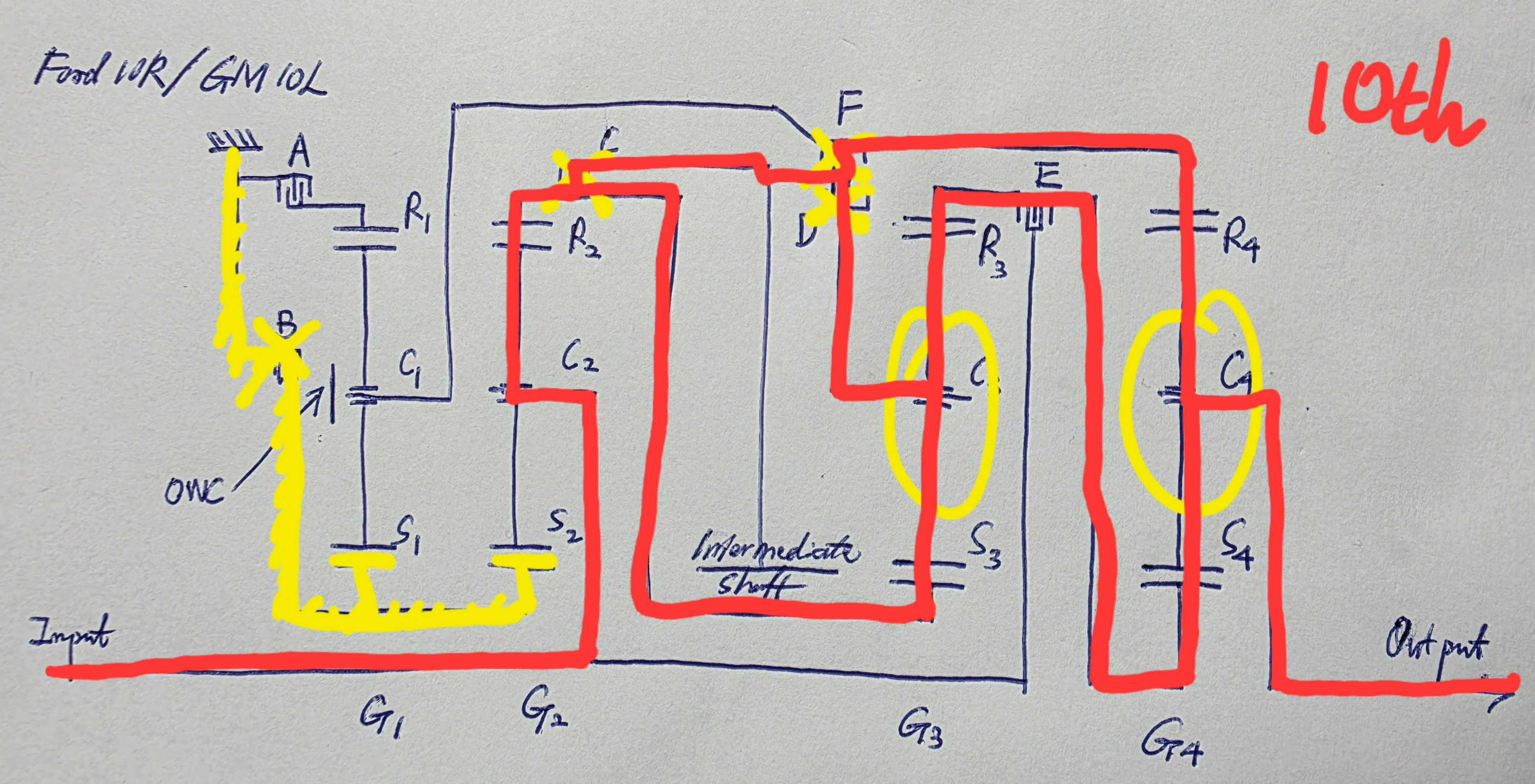
In 10th, torque goes through the many parallel paths as shown. Again, this gear locks G3 and G4. Speed only increases in G2.
Final Words
Overall, about half the speeds of the Ford–GM 10-speed uses similar logics found in the ZF 8HP. However, it is a strong, highly innovative evolution that delivers a class-leading performance in efficiency and drivability. If it can be built with stronger materials and to higher standards, this design could be the industry benchmark on those two original goals.