techXXX
Exterior Styling of a V12 GT—My Car Company 10
Previously, I have covered the engine, the drivetrain, and the chassis of the mid-size grand tourer that I would build, Type 1. Today, let us move onto the exterior styling.
Published by Dr Jiulin Teng on 31 Jan 2026
Keywords: my-car-co
Previously, I have covered the engine, the drivetrain, and the chassis of the mid-size grand tourer that I would build, Type 1. Today, let us move onto the exterior styling.
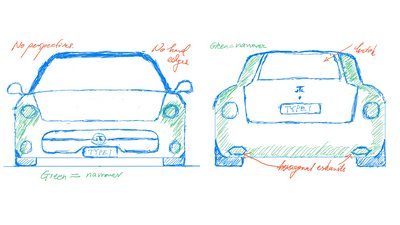
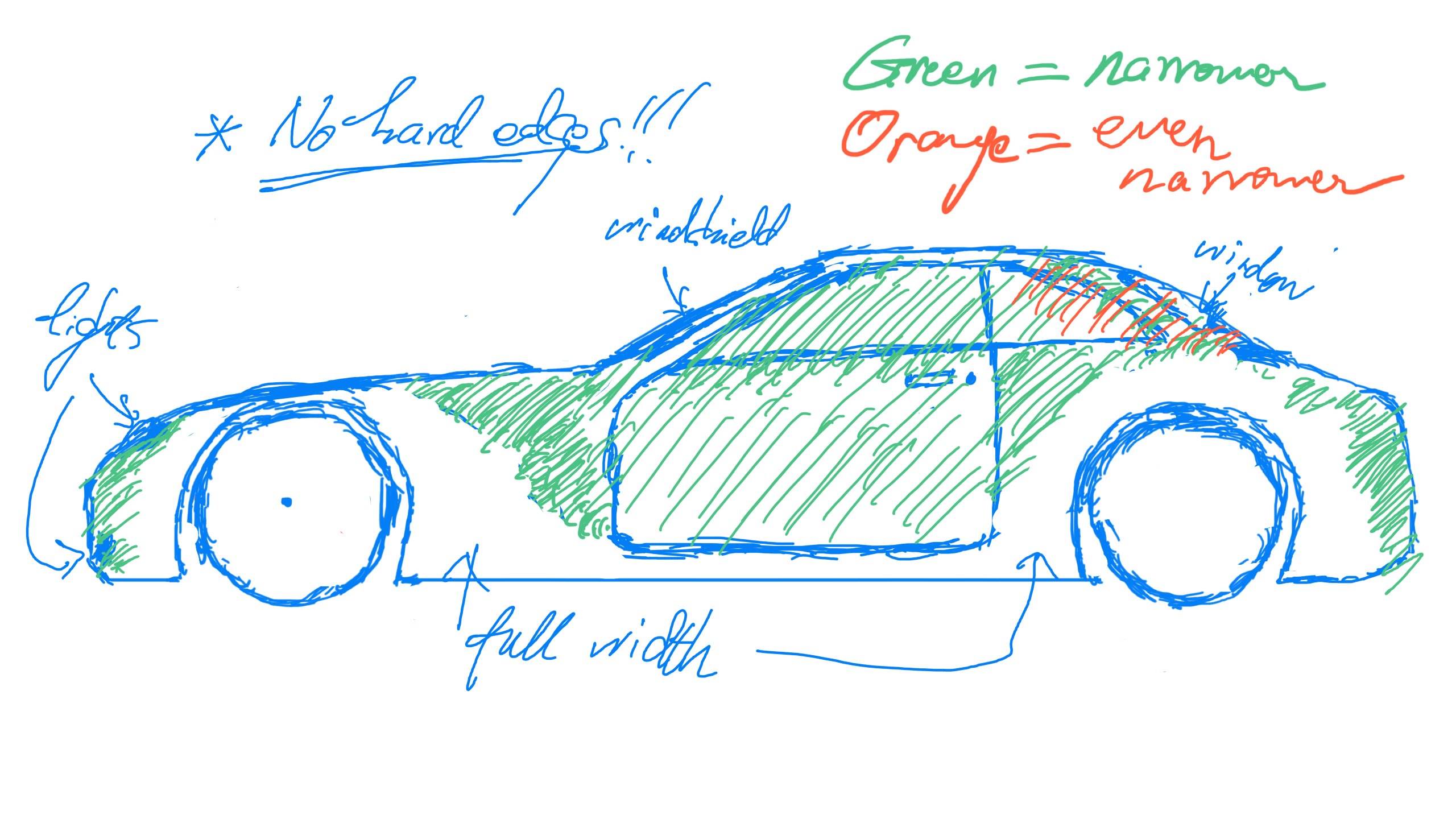
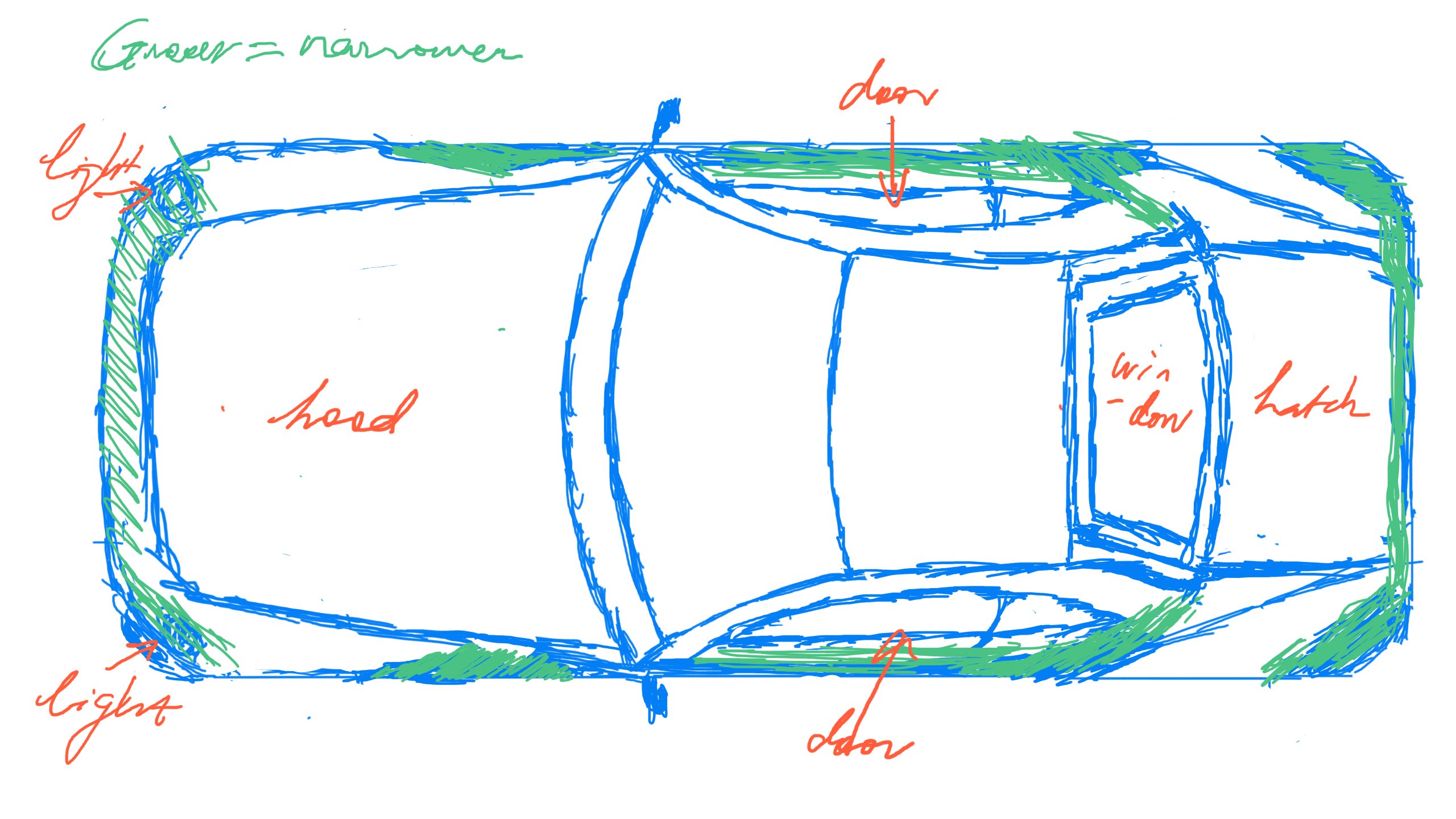
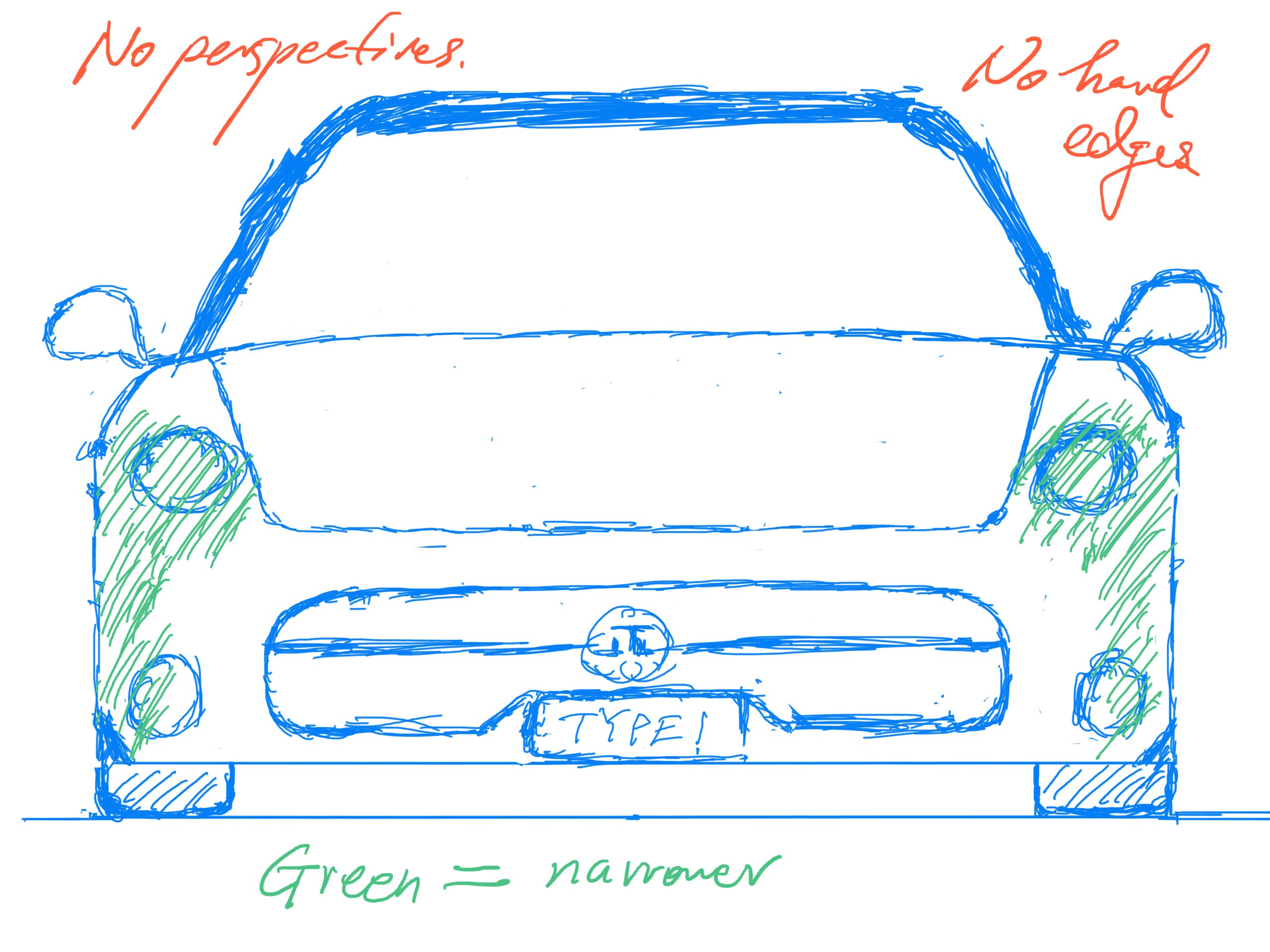
Please note that, because Type 1 does not have any “character line”, it is difficult to draw the exterior up on a flat surface. Keep in mind that I am showing 2D sketches, not 3D objects projected onto a 2D plane. That is, we are not getting the perspectives in them. The key here is that Type 1 will have no hard edges or hard lines; its body will flow continuously with curves.
Exterior Dimensions
We want to build a superlight GT that can be both a tight 2+2 and a well-sized 2-seater. Crucially, I want it to stand out but without resorting to busy styling. Hence, it needs to combine a long engine bay, low overall height, and large wheels.
For practicality, we choose a height of 128cm. Its length is 3.618x the height, thus 463cm. Its width is 1.5x the height, at 192cm. With the mirrors, the widest points should be 1.618x the height apart, thus 207cm. The narrowest points across the roof should be 0.618x the width, at 118cm. The bottom of the windshield above the hood line should be at 0.618x the height from the floor, thus 83cm from the ground, and at 0.382x the total length, at 177cm from the front.
The wheelbase is 2/3 the vehicle length, at 309cm. The front overhang is 74cm, and the rear overhang 80cm. The top of the tires stands at 68cm from the ground. These numbers are chosen for dramatic effect. The short rear overhang also helps with interior space, which would otherwise be very tight as a 2+2.
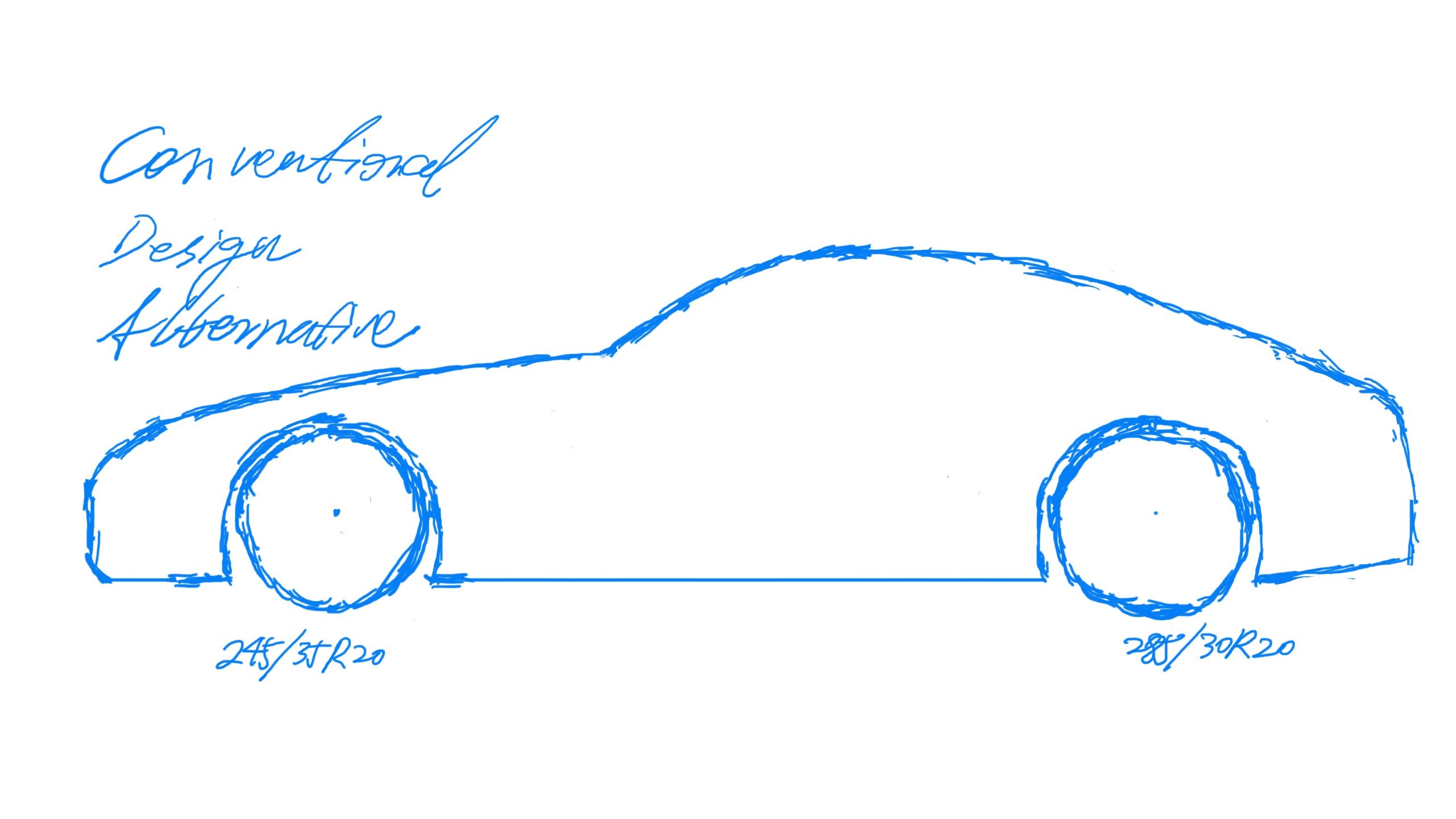
I am fully aware that these numbers are extraordinary. A more conventional design would have the wheelbase perhaps close to 0.618x the vehicle length, at 286cm, with the front and rear overhangs at 88cm each. It would have the wheels at around 0.5x the height, perhaps using 245/35 R19 and 285/30 R19 tires. For modern cars, an alternative would be to keep the wheels but raise the hood to 2/3 the height from the floor, at 89 cm, or from the ground, at 86cm. However, those would look less dramatic than the current design.
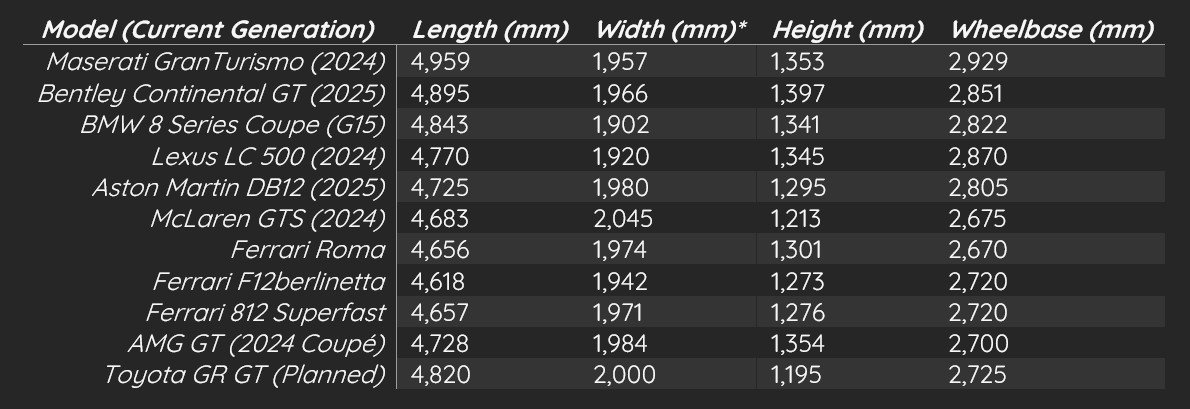
In comparison, according to the internet:
Styling Language
We do not intend for Type 1 to be a super GT like modern V12 Ferraris. Instead, it harkens back to the classics of the 20th century such as the Jaguar E-Type, Ferrari 250 GT, and Toyota GT 2000, etc. Hence, it should not have any bling or “character line” that only serve to mask the boring design of a vehicle. Rather, Type 1 will have continuous, smooth curves that flow coherently throughout. Unfortunately, this is the aspect that I am unable to draw on these sketches.
Colors
As a grand tourer, Type 1 is about long road trips, shifting through the gears yourself, and occasionally revving the engine out. It is about enjoying life. Thus, it will not be offered in black or any shade of grey. The standard colors will include blue, red, and yellow. Paid options will also include bronze, green, orange, purple, silver, and white. Only one shade optimized for the vehicle will be available for each color.
Lights
Type 1 will use circular head and tail light assemblies that embed into the body shell. Their exterior covers will be flush with the exterior curves.
Doors
As a B-pillarless coupe, the doors will be frameless. Unlike modern cars that do this, however, Type 1 will also use manual windows. This requires the edge of the roof to cover the windows fully so that we do not need the window to come down to clear the frame.
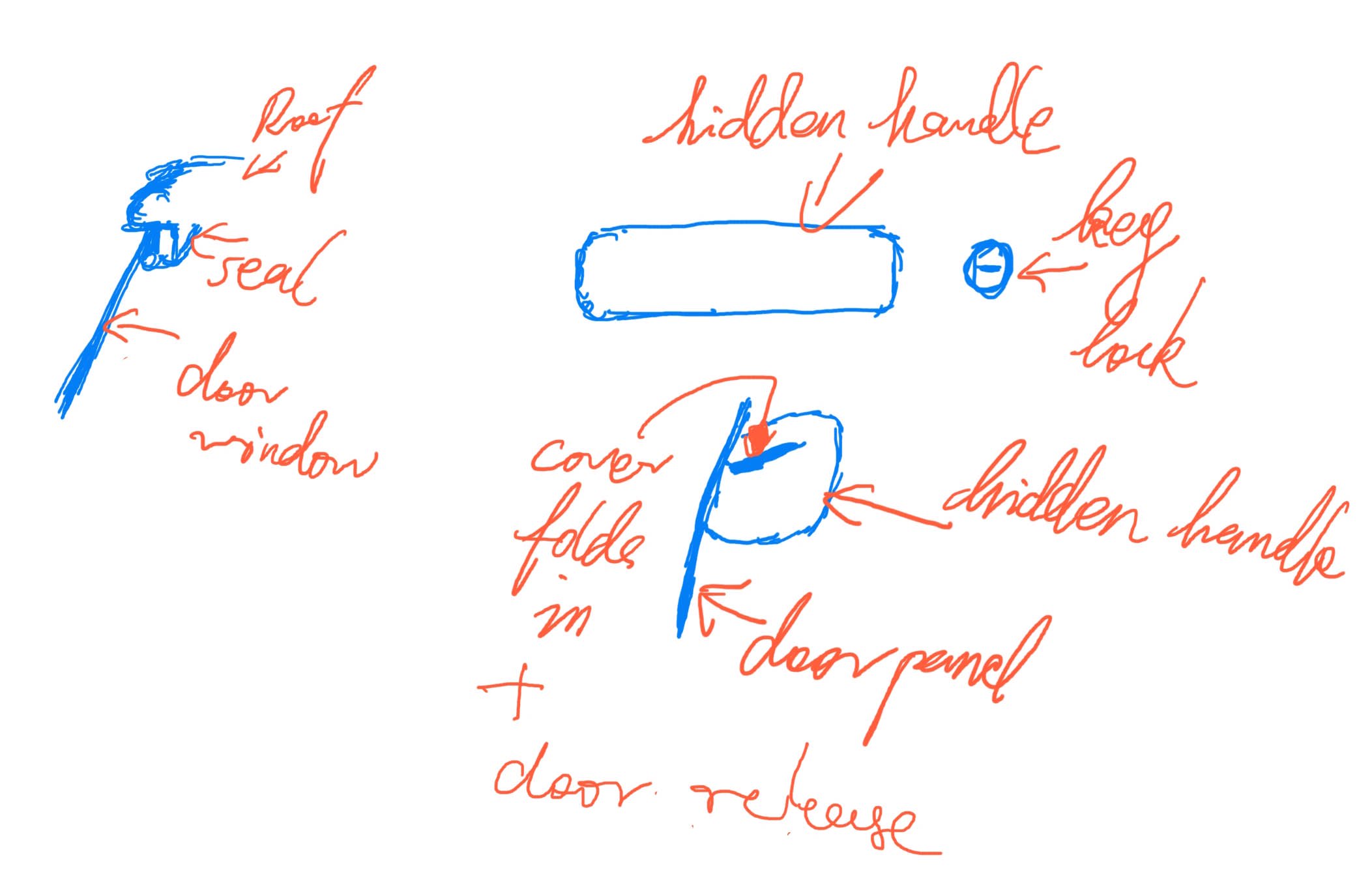
For cleanliness, there will not be any protruding door handles. Instead, we use a cover that keeps the door panel smooth and folds in when pressed to act as a door handle. In the spirit of not using unnecessary electronics, Type 1 will use keyed locks only, one on each door. This makes the action of inserting the key, turning it, and unlocking the door a ritual. Among all the keyless cars today, this adds to the ownership experience.
Rear Hatch
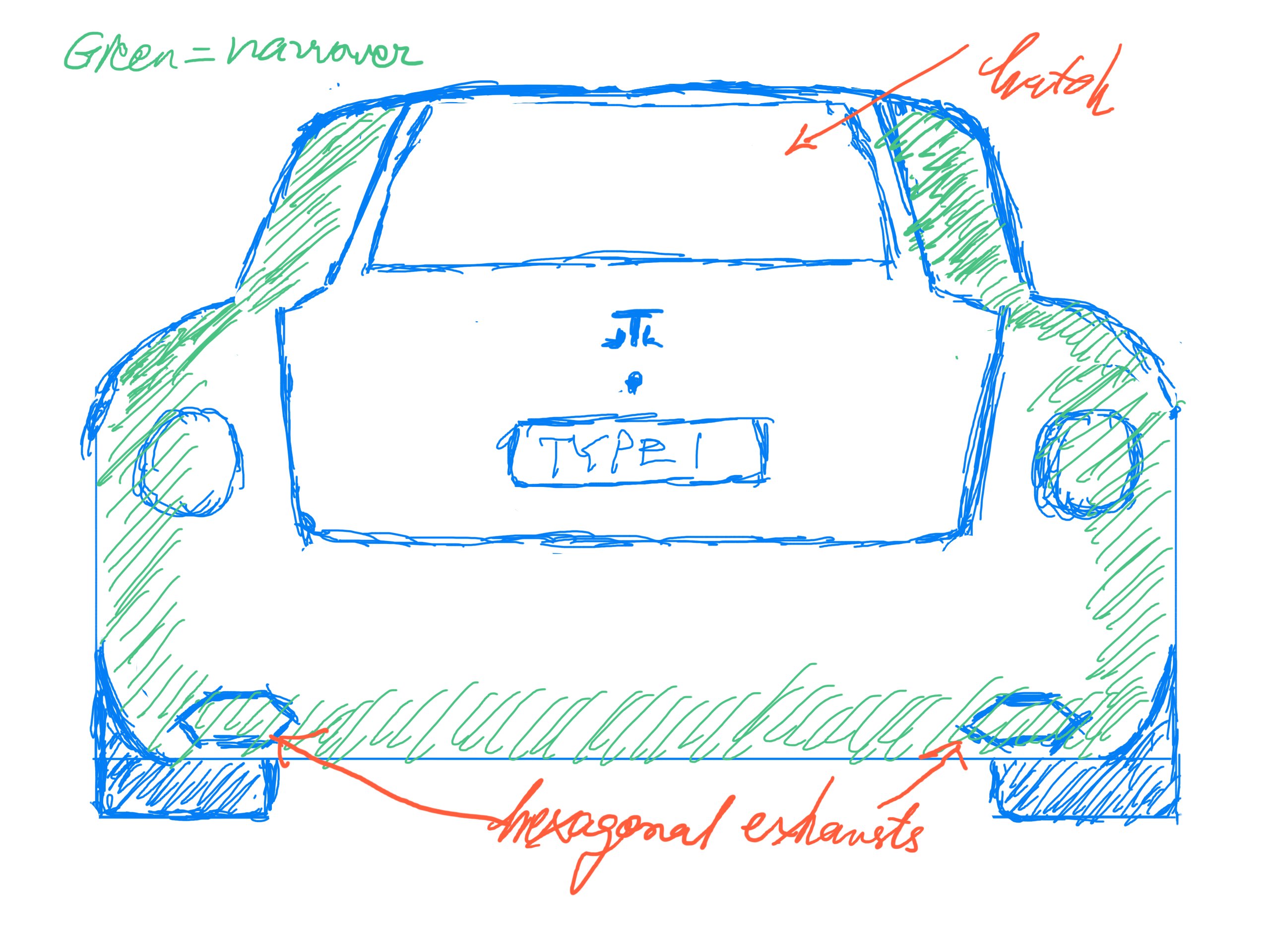
For practicality, Type 1 will have a rear hatch that extends from the top of the rear window to the bumper. Unlike most cars, however, and for pure styling reasons, this hatch will be curved to give the appearance of a trunk.
Front Grille
We will install a wide oblong front grille for all the cooling and intake needs. It will have a bottom notch in the center to accommodate the front license plate. A logo will be in the middle. Behind the plastic grille but in front of the radiator, we will install a metal mesh that prevents damage from road debris.
Exhaust Tips
The only exterior “design elements” on Type 1 are the dual hexagonal exhaust tips. They are here to show the tortoise that you have just blown past that we are powered by a V12.
Next Up
In the next post, I will cover the interior equipment and styling.