techXXX
Understanding the Mercedes 722.9 7G-Tronic Automatic Transmission (W7A 700 / NAG2)
The Mercedes 722.9 7G-Tronic was the world’s first 7-speed automatic transmission for passenger cars. Today, let us analyze the advantages and trade-offs of its design and delve into how its gear train works.
Published by Dr Jiulin Teng on 27 Dec 2025 · Updated on 01 Jan 2026
Keywords: mercedestransmission
Debuted in 2003 in a range of V8-powered vehicles, the Mercedes 722.9 7G-Tronic was the world’s first 7-speed automatic transmission for passenger cars. It has been the subject of mixed opinions throughout its production span. Today, let us analyze the advantages and trade-offs of its design and delve into how its gear train works.
Advantages
1. Mechanical Robustness. Using three gearsets, one Ravigneaux gearset and two simple planetary gearsets, the 7G-Tronic is very robust internally. It has few torque load shocks during shifts and is optimized for smooth gear changes and long life. Its friction elements are placed near site, so large, fragile drums found in some ZF designs are avoided.
2. Brake-Heavy Design (1st-5th). Even though it has many friction elements, the 7G-Tronic is brake-heavy, especially in the lower gears. Therefore, the parts of its internals that actually spin and transmit torque form relatively simple paths.
3. Weight and Size. Thanks to its magnesium casing and good design, this transmission is rather compact and lightweight, especially considering its torque capacity.
Trade-Offs
1. Gear Efficiency. Even though with a brake-heavy design many of its gears do not turn, the 7G-Tronic uses one additional planetary gearset than the Toyota–Aisin 8-speed but only gets 7 gear ratios.
2. Scaling. Like the Toyota–Aisin, the use of complex gearset plus near-site friction elements make scaling difficult. In fact, all 722.9 transmissions, as far as I know, share the exact same mechanical internals. That is, all 7G-Tronics are W7A 700, even though Mercedes claimed that it would “later” introduce a weaker W7A 400, which has been parroted by many as if it had happened. As far as I know, the 7G-Tronic has never been scaled up or down. AMG and V12 versions simply had different tunings and different torque converters. The MCT version also share the same gear train. Lastly, 7G Plus has the exact same gear train, too, just with different mechatronics and oil pump.
3. Tough on Clutch K3. This design, as I shall demonstrate below, relies heavily on K3. It may be rather hard on K3 in the overdrive gears, because of the extra high speed that it needs to operate at. A sign that K3 is worn is hard 4-to-5 shift. A fully worn K3 would prevent the transmission from going into gear.
4. Aggressive TCC Slip. Mercedes wanted to imitate the torque converter lock-up clutch (TCC) slip strategy used in the ZF 6HP, mostly to improve drivability and smoothness. However, one can say that it overshot the target with too much, too aggressive slippages. Coupled with a relatively small TCC and rudimentary electronic control by today’s standards, early 7G-Tronics suffer from frequent torque converter failures. Mercedes revised the torque converter design and ETC (electronic transmission control) software several times to address this. Supposedly, AMG versions with more positive lock-up would last considerably longer.
Gear Train
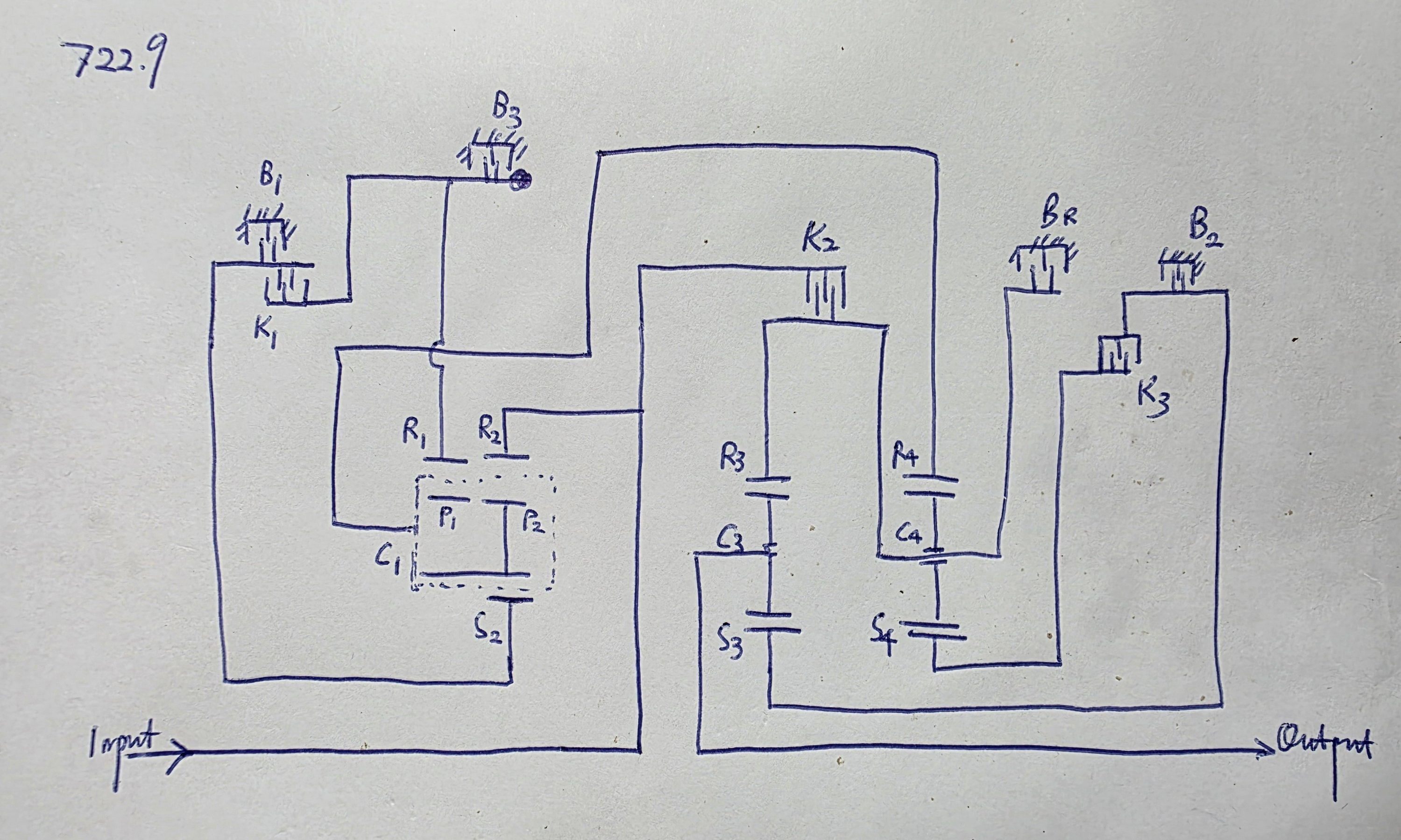
Let us now move our attention to the schematic of the gear train, which was drawn by me. K1 through K3 are the clutches, B1 through B3 the brakes, and BR the reverse brake, which is not used in the forward gears. C1 through C4 are the planet carriers, S2 through S4 the sun gears, and R1 through R4 the ring gears. I also marked out P1 and P2 as the two sets off pinons in the Ravigneaux gearset. Several points are worth noting:
- This Ravigneaux gearset has only one sun gear (S2) and two ring gears (R1 and R2). This is the reverse of the example we saw in the Toyota–Aisin 8-speed. P2, which meshes with S2 and R2 is the long pinon. It is meshed to the short pinon P1.
- Input goes directly to ring gear R2 and, via K2, optionally to the rear planetary gearsets.
- Output is through the C3 carrier. Thus, the 7G-Tronic does not use an intermediary shaft.
Torque Paths
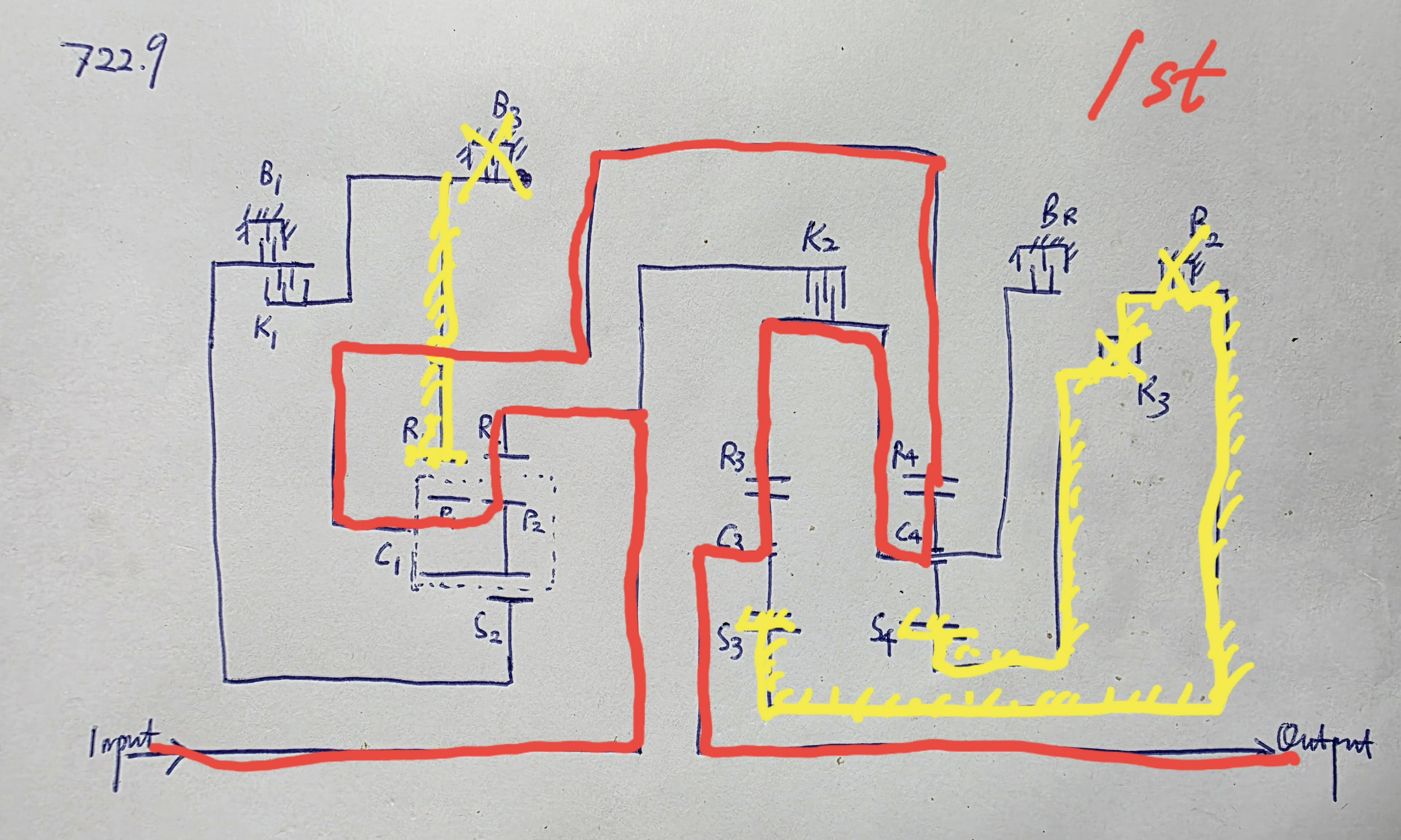
In 1st, torque goes through R2 > P2 > C1 > R4 > C4 > R3 > C3. Because B3 brakes R1, C1 is forced to rotate along it when power is sent to R2. This speed reduction is compounded by further speed reductions in the two rear planetary gearsets, both have torque going in the ring gear and out the carrier.
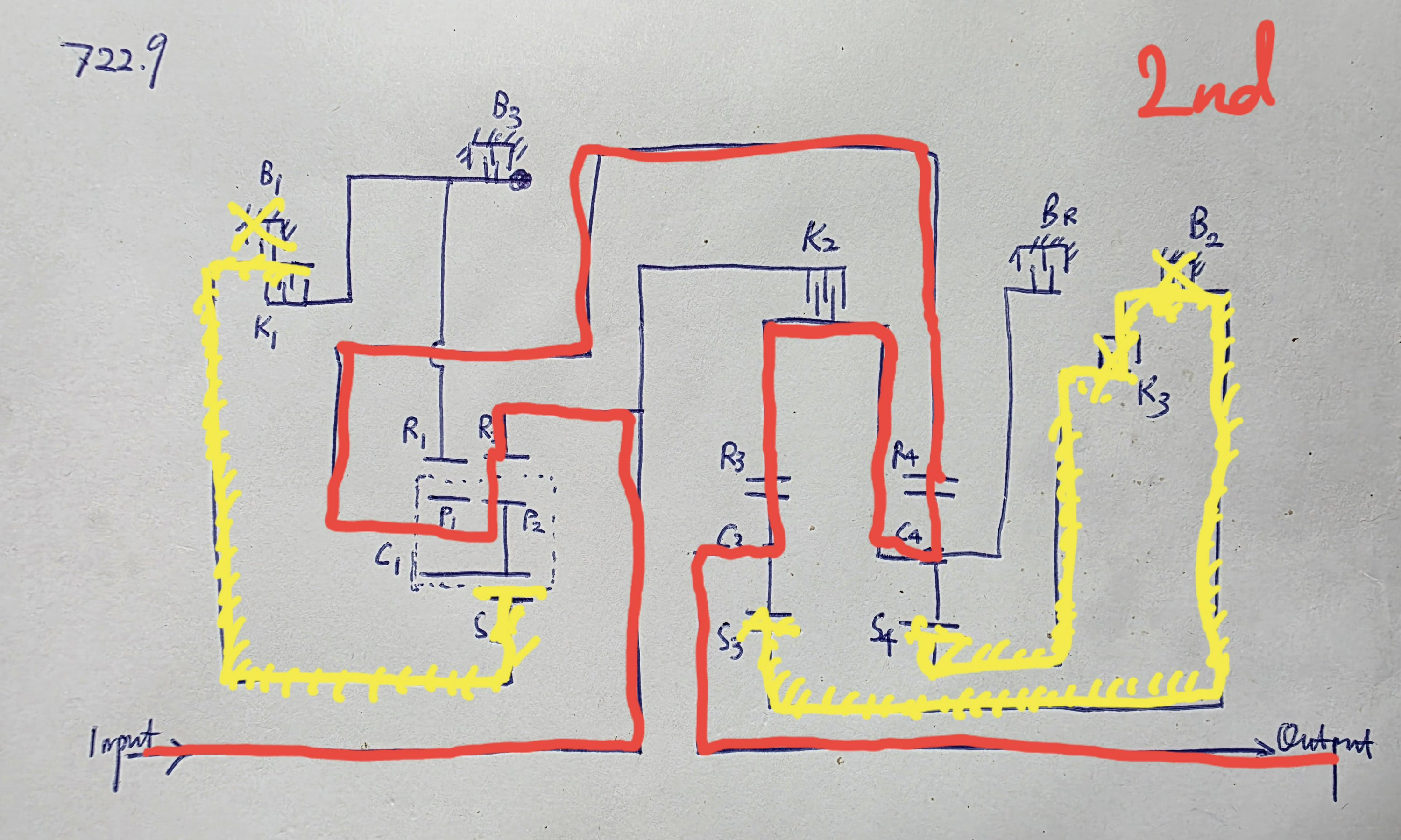
In 2nd, torque goes through R2 > C1 > R4 > C4 > R3 > C3. Because B1 brakes S2, the Ravigneaux gearset behaves like a simple planetary gearset, again with torque going in the ring gear and out the carrier.
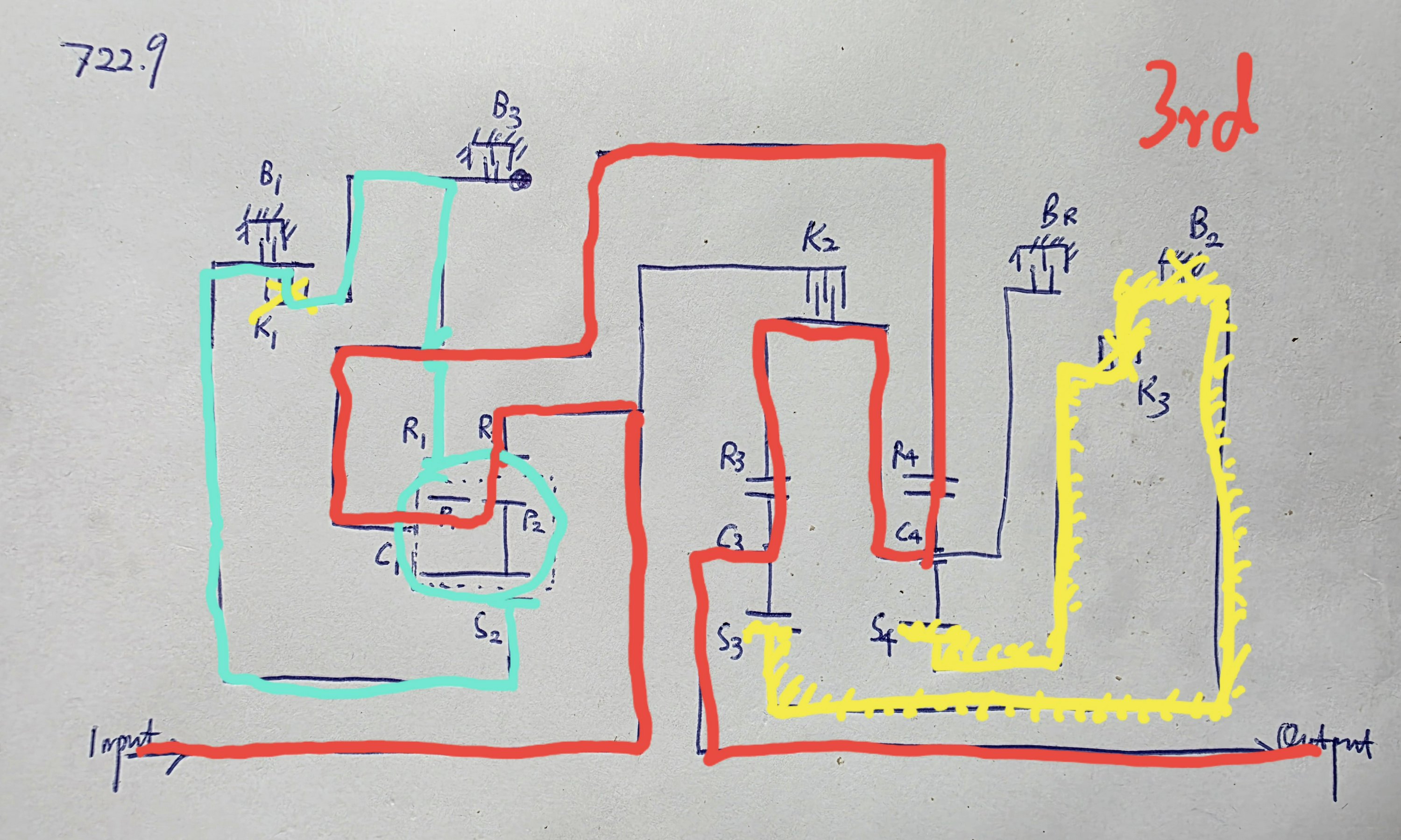
In 3rd, torque goes through R2 > C1 > R4 > C4 > R3 > C3. Because K1 connects S2 to R1, it locks the Ravigneaux gearset as one. There is no speed reduction until power reaches the rear planetary gearsets.
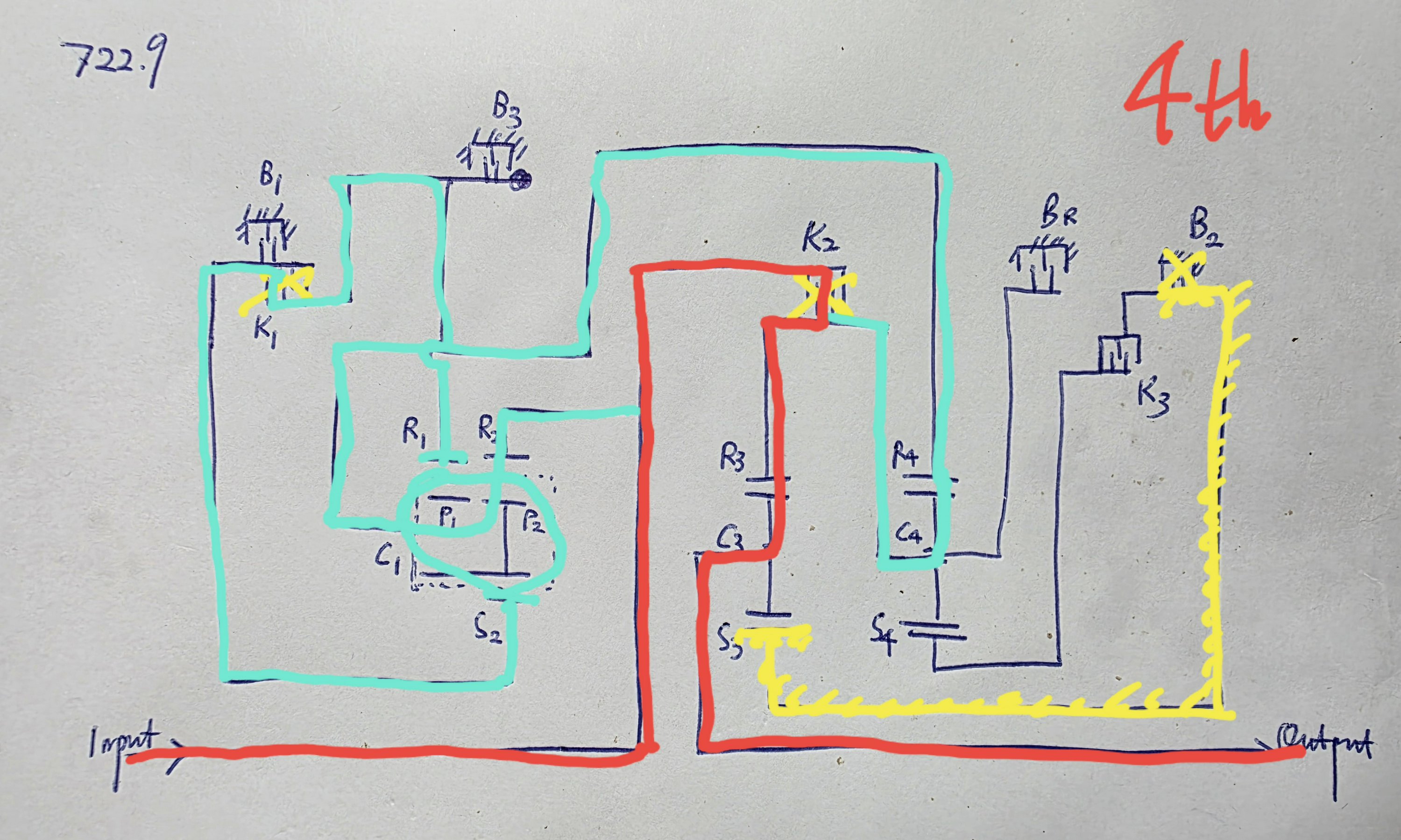
In 4th, torque goes through K2 > R3 > C3. R2 > C1 > R4 would also turn, but because nothing is held still at the rear planetary gearset, this path cannot transmit torque but is only forced to turn parasitically.
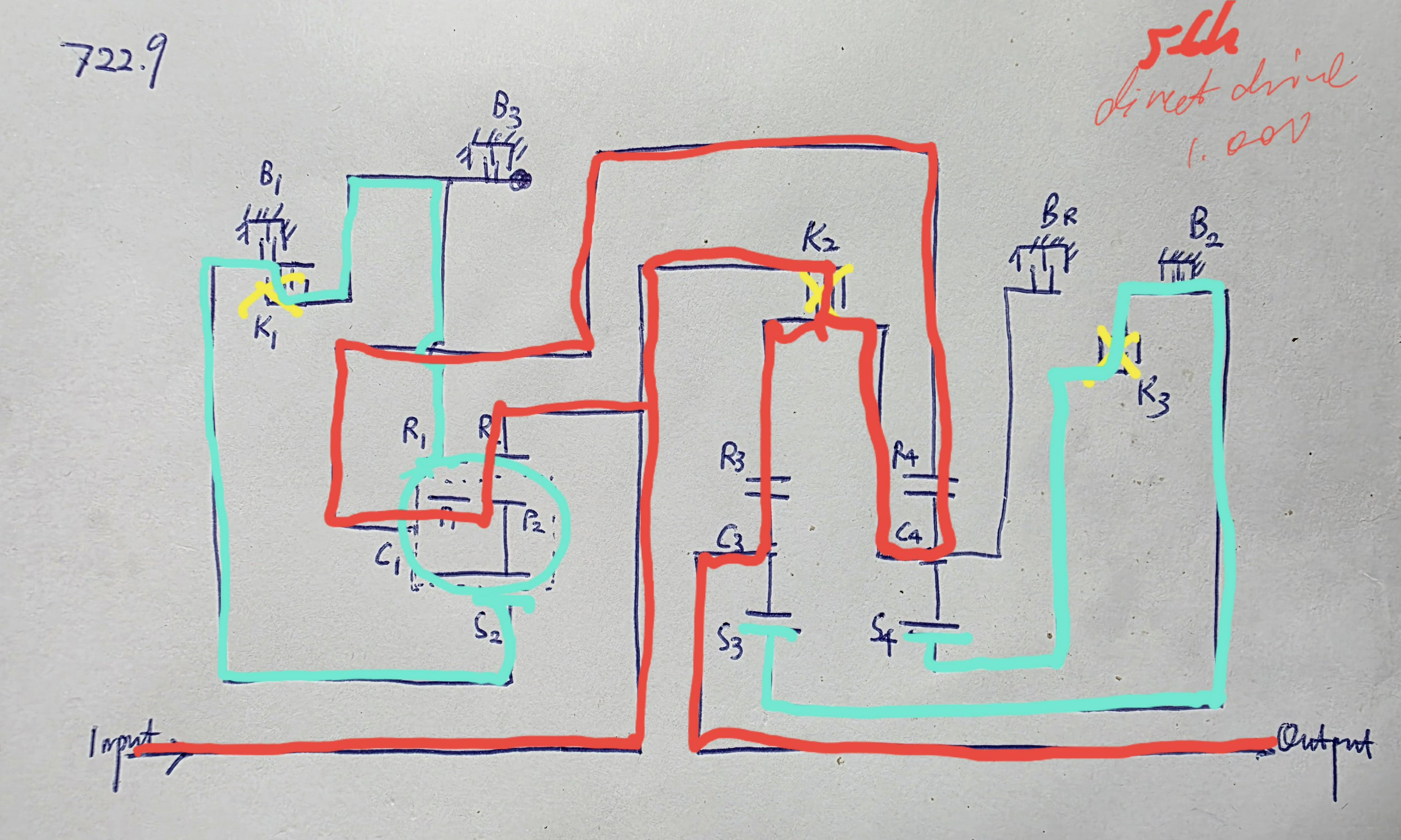
In 5th, torque goes through K2 > R3 > C3. R2 > C1 > R4 > C4 > R3 > C3 also turn. Because K3 connects the two rear sun gears, it forces the two rear planetary gearsets to turn as a unit. This is equivalent to the direct drive of a Simpson gearset. Thus, we get direct drive out of this transmission.

In 6th, torque goes through K2 > C4 > S4 > K3 > S3 > C3. R2 > C1 > R4 also turn, but at a lower speed. This forces S4 and, via K3, S3 to go very fast. Meanwhile, K2 > R3 also turn, but is slower than S3. The output speed at C3 is actually reduced.

In 7th, torque goes through K2 > C4 > S4 > K3 > S3 > C3. R2 > P2 > C1 > R4 also turn, but at a lower speed. Notably, this is an even lower speed than in 6th, thus the speed difference between C4 and R4 is greater, resulting in even higher speed at S4 and S3. Thus, 7th is faster.
Additional Remarks
Gears 1, 2, and 3 are essentially the classic Ravigneaux gear ratios. What is great about this design is that torque does not go through any clutch. Conceptually, B1 converts the Ravigneaux gearset to a simple planetary gearset. K1 neutralizes the Ravigneaux gearset. K3 converts the rear gearsets into a Simpson gearset.