techXXX
Small DI Turbo vs Large NA PFI: Why Emissions Is NOT Killing the V12
I explain why emissions requirements are driving a comeback of large displacement, naturally-aspirated, port-injected engines.
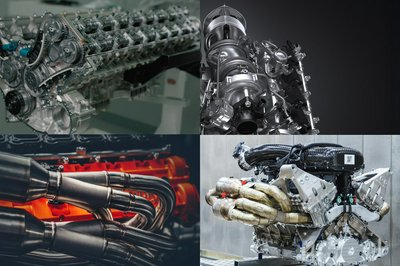
About two years ago, I made a small, but unclear video about the return of the large displacement, naturally-aspirated engine. Today, let us delve into why this is the case. More interestingly, by the end you will understand why the small turbos are also here to stay, but that it is mid-to-large turbo engines that may disappear from the mainstream.
Emissions Requirements: The Driver
For decades, emissions requirements have been the primary driver of changes in the design of internal combustion engines. Indeed, without these nagging rules tightening all the time, automakers would have been satisfied with the thermal efficiencies of the 1970s, and car buyers could not imagine the specific output or fuel efficiency of internal combustion today. However, the upcoming Euro 7 and their equivalents are making certain designs untenable.
On the one hand, and as has been the case in the last decade, hydrocarbon emissions must be next to zero, and almost immediately after cold start. This strongly favors small engines that run hot. On the other hand, NOx and particulate emissions must also be extremely low, and in the real-world up to 200,000km. Indeed, and as has been advertised by some cheesy manufacturers, real-world emissions should be cleaner than the air quality in about half the globe.
Crucially, while Euro 7 has the same limits as Euro 6 on paper, these requirements are extended beyond lab tests and with a durability requirement.
We know that direct-injected, turbocharged engines emit more in the real world than in labs. Indeed, their emissions performance worsens as carbon builds up, injectors get clogged, and turbo seals deteriorate. On the other hand, port-injected, naturally-aspirated engines perform more reliably in the real world over time.
Winner One: Large NA PFI
It is no wonder that many exciting exotics are popping up with V12 or even V16 naturally-aspirated engines. Compared to forced induction, it is simply easier to make power with more displacement while satisfying emissions. The main challenge is the necessity to light off the catalytic converters within 60 seconds after cold start, which is the window that regulation allows. This is achieved by having more, smaller catalysts combined with secondary air injection and more precise electronic control.
Note that PFI (port fuel injection) is needed to avoid complex exhaust aftertreatment systems, because DI (direction injection) leads to more violent combustions that result in higher particulate and NOx emissions.
Historically, the move away from large displacement NA engines was mainly motivated by corporate average fuel economy (CAFE) requirements in the US. These large NA engines are inherently less fuel efficient, because they run cooler, and have lower specific output. However, since no one expects to sell many V12s or V16s anyway, it is not an issue for this unique segment.
Winner Two: Small DI Turbos
The thing about the fuel economy genie is that you cannot put it back in the bottle. Even though the US has all but eliminated CAFE-related fines, car buyers have come to expect certain fuel economy numbers. Indeed, running costs are becoming a major weakness against the onslaught of EVs as it is.
Thankfully, it is easier to make small engines meet emissions requirements than larger ones, in the real world as it is in labs. The key is to build them as if building diesel engines, with almost all the diesel exhaust aftertreatment equipment that we have come to expect. With more hybridization and electrification, the performance gap is quickly closing. There simply is less of a need for V6 or V8.
Loser: Mid/Large DI Turbos
The same cannot be said about mid-to-large turbo DI engines. Already, they are at a disadvantage in terms of emissions. Only a handful of automakers still make turbocharged V8s because of it. I would not be surprised if in a few years’ time a dieselgate-like scandal breaks out surrounding certain German hot-V8s that will kill them off altogether. Before then, wealthy enthusiasts will move on to NA V12s and V16s that provide a superior motoring experience from linear power delivery to exhilarating soundtrack.